
Blog
Parkinson’s Disease and Fatigue: The Non-Motor Symptom Most Patients Never Expected


Parkinson's Disease and Fatigue: The Non-Motor Symptom Most Patients Never Expected
Most people picture tremor first when they think of Parkinson's disease. But ask people actually living with it, and fatigue is frequently named as one of the hardest symptoms to manage — sometimes arriving years before any visible movement changes at all. An estimated 50-70% of people with Parkinson's experience significant fatigue. Here's what's actually happening with dopamine and energy signaling, how it connects to medication timing, and what genuinely helps.
- An estimated 50-70% of people with Parkinson's disease experience significant fatigue, and it can appear well before, or entirely separate from, the tremor and movement changes most people associate with the disease.
- It has a specific mechanism: the decline of dopamine-producing cells disrupts signaling in the basal ganglia — the brain circuitry that governs both movement and energy regulation, not movement alone.
- There are two recognized types: "central" fatigue, generated by the brain itself, and "peripheral" fatigue, related to muscle and physical exertion — and they respond to different strategies.
- Medication timing matters enormously. Many people notice fatigue spikes as a dose of levodopa wears off — a pattern distinct from ordinary tiredness and worth tracking specifically.
- It's manageable. Exercise, sleep-disorder treatment, and medication-timing conversations with a neurologist all make a measurable difference.

1. Why Parkinson's Fatigue Catches People Off Guard
Mayo Clinic describes Parkinson's disease as a progressive nervous system disorder that affects movement, most recognizably through tremor, stiffness, and slowed movement — but the same source also notes that Parkinson's involves a long list of non-motor changes well beyond movement itself. Fatigue rarely makes the first mental checklist, even though clinical literature consistently ranks it among the most burdensome symptoms people actually report.
Part of what makes it confusing is timing. For some people, a persistent, unexplained tiredness shows up years before any tremor or stiffness is noticeable — part of a group of early, non-motor changes that can precede a formal diagnosis. For others, fatigue becomes most noticeable only after diagnosis, once medication and daily routines are already part of the picture, which can make it hard to tell what's causing what.
2. The Dopamine-and-Energy Connection
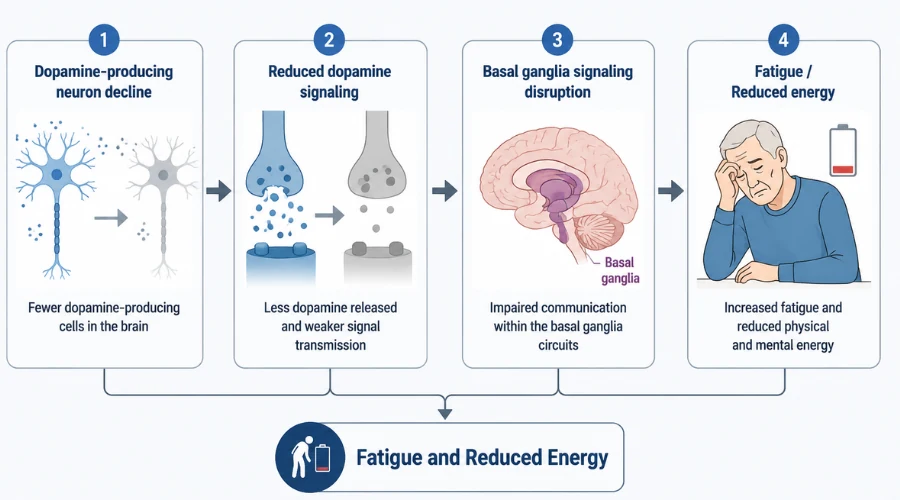
Parkinson's disease develops as dopamine-producing cells in a brain region called the substantia nigra gradually decline. Dopamine is best known for coordinating smooth, intentional movement, but the same basal ganglia circuitry it supports is also involved in motivation, effort perception, and energy regulation — which helps explain why a movement disorder produces a symptom as far-reaching as whole-body fatigue.
Clinical literature on the topic, summarized in resources like NCBI/StatPearls, distinguishes two broad categories of fatigue in Parkinson's. Central fatigue is generated within the brain itself — a sense of mental and physical depletion that isn't explained by exertion and doesn't necessarily improve with rest. Peripheral fatigue relates more directly to muscles and physical exertion, including the extra energy cost of moving through rigidity or slowed movement. Many people experience a mix of both at once.
- Central fatigue feels like mental and physical depletion that can be present even at rest, unrelated to how much a person has physically done that day.
- Peripheral fatigue relates to muscle effort — moving through stiffness or slowed movement simply costs more energy than it used to.
- Both types can coexist, which is part of why a single explanation ("I just overdid it") often doesn't capture the full picture.
- Fatigue doesn't track neatly with visible motor symptom severity. Someone with mild tremor can have significant fatigue, and vice versa.
- Apathy and fatigue are related but distinct. Apathy is a lack of motivation or initiative; fatigue is a sense of depleted energy — the two frequently overlap but call for different conversations with a care team.
3. Fatigue Across the Disease Timeline
Fatigue in Parkinson's doesn't behave like a single, steady symptom. For some, it's part of a cluster of subtle early changes — alongside a reduced sense of smell or sleep changes — that appear before a formal diagnosis is made. Once someone is on treatment, fatigue can then rise and fall through the day in step with medication timing (Section 5), and clinical literature also describes it as a symptom that frequently persists across the entire disease course, independent of how advanced the motor symptoms have become.
This matters practically: a fatigue pattern that changes hour to hour is a different clinical question than one that's simply present, unchanging, every single day. Bringing the specific pattern — not just "I'm tired" — to a neurology appointment makes a real difference in how it gets addressed.
4. Central vs. Peripheral Fatigue: What Points Where
Since these two categories respond to different strategies, it's worth getting a general sense of which one is showing up more.
A mental and physical heaviness that isn't tied to activity
Present even after rest, not clearly linked to how much was physically done that day, and often described as difficulty initiating or sustaining effort — points toward the brain-based mechanism in Section 2.
Muscles that tire faster during physical tasks
Fatigue that builds specifically during movement, walking, or physical activity, and improves with rest, points toward the muscular/exertion-based pattern.
These aren't mutually exclusive, and a broader evaluation (Section 9) — not a self-diagnosis — is the right way to sort out which is dominant, especially since sleep, mood, and medication timing all interact with both types.
5. The Medication Timing Connection: "Off-Time" Fatigue

This is one of the most specific and least-discussed features of Parkinson's fatigue. Levodopa, the most common Parkinson's medication, works in a defined window after each dose — often described by clinicians and patients alike as "on" time, when medication is working well, and "off" time, when its effects wear off before the next dose. According to patient-education materials from the Parkinson's Foundation, fatigue is one of the symptoms that can intensify noticeably during these "off" periods, alongside stiffness and slowed movement.
Off-time fatigueA pattern of fatigue that predictably worsens as a levodopa dose wears off, and improves again once the next dose takes effect. Distinct from constant, all-day fatigue because it fluctuates on a schedule tied to medication timing. has a specific, recognizable shape: it worsens predictably before a dose and eases again once the next one takes effect. That pattern — rather than a flat, all-day tiredness — is exactly the detail worth bringing to a neurologist, since it often points toward a medication-timing adjustment rather than a lifestyle change.
- A fatigue "clock" that lines up with medication timing is a meaningful clue, distinct from fatigue that stays flat all day regardless of dose schedule.
- This pattern is common and expected, not a sign that a medication has stopped working altogether — many people find real improvement through dose-timing adjustments.
- Keeping a simple log (Section 11) of dose times against energy levels is often the single most useful piece of information a movement-disorder specialist can be given.
- This is a conversation for a neurologist, not a self-adjustment. Changing dose timing or amount should always go through the prescribing clinician.
If your energy noticeably dips before a scheduled dose and picks back up after it, that's a recognized pattern worth naming specifically at your next appointment — not something to just push through.
6. Who's Most Often Affected
People Earlier in the Disease Course
Fatigue can be disproportionately prominent relative to visible motor symptoms in earlier-stage Parkinson's, which is part of why it's easy to underestimate at first.
People With Coexisting Depression or Apathy
Mood-related non-motor symptoms are common in Parkinson's and are closely linked with fatigue, often compounding each other.
People With Sleep Disruption
REM sleep behavior disorder, insomnia, and fragmented sleep are all more common in Parkinson's and contribute directly to daytime fatigue.
People on Complex Medication Schedules
More frequent dosing intervals mean more opportunities for "off-time" fatigue described in Section 5.
People With Orthostatic Blood Pressure Changes
Autonomic symptoms, including blood pressure drops on standing, are common in Parkinson's and can contribute to a fatigued, foggy feeling distinct from the central/peripheral fatigue described above.
7. Interactions: Sleep, Mood, and Medications
Fatigue in Parkinson's rarely exists in isolation from these other common, related symptoms.
- REM sleep behavior disorder — acting out dreams during sleep — is notably more common in Parkinson's and can fragment sleep without the person fully realizing it, contributing directly to daytime fatigue.
- Depression and apathy frequently accompany Parkinson's and can be difficult to separate from fatigue without a specific conversation about mood, motivation, and interest in activities.
- Some Parkinson's medications list drowsiness or fatigue as a possible side effect. If fatigue changed noticeably after starting or adjusting a medication, that timing is worth flagging directly.
- Nighttime motor symptoms — stiffness, difficulty turning over in bed — can disrupt sleep quality even without a formal sleep disorder diagnosis.
- Blood pressure drops on standing (orthostatic hypotension) can produce a lightheaded, fatigued feeling that's worth distinguishing from central or peripheral fatigue.
If your fatigue has changed, try to note whether it lines up with a medication adjustment, a stretch of disrupted sleep, a mood shift, or a specific time relative to your dose schedule — that specificity makes the evaluation in Section 9 far more productive.
8. Real-World Scenarios: Where Do You Fit?
"My energy drops like clockwork before my next dose, then picks back up."
A pattern consistent with off-time fatigue tied to medication timing, described in Section 5.
"I'm exhausted even on days I haven't done much physically."
More consistent with central fatigue — a brain-based pattern not explained by exertion, described in Section 2 and Section 4.
"I wake up tired no matter how many hours I slept."
Worth raising sleep quality and REM sleep behavior disorder specifically with your neurologist, described in Section 7.
"I've also lost interest in things I used to enjoy, not just energy."
Worth a specific conversation about mood and apathy, which are related to but distinct from fatigue itself, described in Section 2 and Section 6.
9. How Parkinson's-Related Fatigue Is Actually Evaluated
A Parkinson's diagnosis itself is a clinical one, guided by criteria such as the UK Parkinson's Disease Society Brain Bank criteria, which look at a defined combination of movement signs. Once someone is already diagnosed, evaluating fatigue specifically is a separate, more targeted process.
| Step | What it involves |
|---|---|
| 1. Fatigue-specific history | When it happens, whether it tracks with medication timing (Section 5), and whether it's central, peripheral, or both (Section 4). |
| 2. Sleep review | Screening for REM sleep behavior disorder, insomnia, and nighttime motor symptoms that disrupt rest. |
| 3. Mood and apathy screening | Distinguishing depression and apathy from fatigue itself, since all three commonly overlap in Parkinson's. |
| 4. Medication and dose-timing review | Mapping energy levels against the dosing schedule to identify off-time fatigue. |
| 5. Ruling out unrelated causes | Anemia, thyroid function, orthostatic blood pressure changes, and other treatable contributors independent of Parkinson's itself. |
As with many chronic conditions, the most common trap is attributing all fatigue to "the Parkinson's" without working through these layered steps — since several of the contributing factors above are genuinely treatable on their own.
10. Try It: Fatigue Pattern Finder
Which best describes your fatigue pattern?
Tap the option that fits best to see what that pattern often points to.
Not a diagnostic tool — for education only. Bring your specific pattern to a neurologist.
11. What to Track Between Appointments

A few specific details make fatigue conversations with a movement-disorder specialist far more actionable than a general "I'm exhausted" description.
A simple daily energy rating, logged at the same times relative to your doses
Reveals off-time patterns that a memory-based description tends to miss (Section 5).
Whether fatigue is present at rest or mainly during activity
Helps distinguish central from peripheral fatigue, described in Section 4.
Sleep quality, including any dream-enactment or restless nights
Directly supports evaluation of REM sleep behavior disorder, described in Section 7.
Mood and motivation, rated separately from physical energy
Helps separate fatigue from depression or apathy, described in Section 6 and Section 9.
Exact dose times and any recent medication changes
Precise timing makes off-time fatigue far easier for a neurologist to identify and adjust for (Section 5).
12. The 2026/2027 Edge: Where Parkinson's Fatigue Care Is Heading
Non-motor symptoms — fatigue very much included — have become a growing research focus in Parkinson's, partly because they're often reported as more disruptive to daily life than motor symptoms alone. Structured exercise programs are increasingly built into standard Parkinson's care rather than treated as optional, with growing evidence that regular activity meaningfully supports both motor function and energy levels.
Research interest has also grown around better distinguishing central from peripheral fatigue using objective measures, refining how sleep disorders like REM sleep behavior disorder are screened for and treated earlier, and exploring whether earlier, more individualized medication-timing adjustments can reduce off-time fatigue specifically. None of this changes the core approach for most people today: the layered evaluation in Section 9, paired with the practical strategies in Section 14, remains the foundation of care.
13. Red Flag Symptoms: When Fatigue Requires Prompt Medical Evaluation
Most Parkinson's-related fatigue is uncomfortable but expected. Certain patterns call for a prompter evaluation rather than waiting for a routine appointment:
- A sudden, significant change in alertness or new confusion, which can have several causes that need urgent evaluation.
- Fainting or near-fainting on standing, which may point to a significant blood-pressure drop needing prompt assessment.
- New or worsening swallowing difficulty alongside fatigue, since this can affect nutrition and hydration and warrants a timely conversation with your care team.
- A fever alongside worsening symptoms, since an infection can trigger a temporary but significant symptom flare.
- Significant, worsening low mood or thoughts of self-harm alongside chronic fatigue — this always warrants prompt professional support regardless of the underlying cause.
14. What Actually Helps, Beyond the Diagnosis

Management approaches for Parkinson's fatigue generally combine medication-timing conversations with practical, evidence-informed daily strategies.
Bring your dose-timing pattern to your neurologist
If your log (Section 11) shows a clear off-time pattern, a dose-timing adjustment is often the single most effective fix available (Section 5).
Build in regular, structured exercise
Current guidance increasingly supports this as an active management tool for both motor symptoms and fatigue, described in Section 12.
Treat sleep disruption as its own target
Addressing REM sleep behavior disorder or insomnia directly often improves daytime fatigue more than any single Parkinson's-focused intervention alone (Section 7).
Practice energy pacing across the day
Scheduling demanding tasks during your typical "on" windows and building in rest before exhaustion hits, rather than after, is a practical extension of the timing awareness in Section 5.
Raise mood and motivation as their own topic
Treating depression or apathy specifically, when present, is a distinct conversation from fatigue itself and can meaningfully improve day-to-day energy (Section 6 and Section 9).
15. Decision Guide — Your Situation, Your Next Step
| Your situation | Most relevant next step |
|---|---|
| Energy rises and falls with your medication schedule | Track exact dose timing against energy (Section 11) and raise it as off-time fatigue at your next appointment (Section 5). |
| Fatigue present even without much physical activity | Describe this specifically as a possible central fatigue pattern (Section 2 and Section 4). |
| Tired regardless of how much you slept | Ask specifically about REM sleep behavior disorder and sleep quality (Section 7). |
| Fatigue accompanied by low motivation or interest | Ask for a specific mood and apathy evaluation alongside the fatigue conversation (Section 6 and Section 9). |
| Sudden confusion, fainting, or swallowing difficulty | Seek prompt evaluation rather than assuming it's ordinary fatigue (Section 13). |
16. Frequently Asked Questions
Is fatigue really a symptom of Parkinson's, or is it just from getting older?
Why does my energy crash right before my next medication dose?
What's the difference between central and peripheral Parkinson's fatigue?
Can exercise make Parkinson's fatigue worse?
Does Parkinson's fatigue mean the disease is progressing quickly?
When should I see a doctor about worsening Parkinson's-related fatigue?
Ask about the pattern, not just the tiredness
- Parkinson's fatigue is real and biological — a direct result of disrupted dopamine signaling in circuitry that governs both movement and energy.
- Medication timing is often the missing piece — off-time fatigue is a specific, trackable, and frequently adjustable pattern.
- Central and peripheral fatigue often coexist — sleep, mood, and exertion are each worth their own specific conversation.
- It doesn't only track with visible motor symptoms — fatigue can be prominent early, and independent of disease stage.
- Exercise, sleep care, and dose-timing adjustments all genuinely help — this is a manageable symptom, not something to simply endure.
Parkinson's Fatigue & Medication Timing Tracker (PDF)
A simple, printable daily log to track energy levels against dose timing, sleep, and mood — the exact details from Section 11 that make your next neurology appointment more productive.
References
- Mayo Clinic — Parkinson's Disease: Symptoms & Causes. mayoclinic.org — Parkinson's Symptoms & Causes
- Parkinson's Foundation — Fatigue. parkinson.org — Understanding Fatigue in Parkinson's
- StatPearls (NCBI Bookshelf) — Parkinson's Disease. ncbi.nlm.nih.gov — Parkinson's Disease Overview
- Cleveland Clinic — Parkinson's Disease: Non-Motor Symptoms (patient education guidance referenced via clinical literature on Parkinson's fatigue management).
- Mayo Clinic Press — Living Well With Parkinson's Disease (referenced via clinical literature on non-motor symptom management).



4 thoughts on “Parkinson’s Disease and Fatigue: The Non-Motor Symptom Most Patients Never Expected”