
Blog
Estrogen and Fatigue: Why Hormonal Shifts Drain Your Energy at Every Life Stage, Not Just Menopause


You Don't Have to Be "In Menopause" for Estrogen to Be the Reason You're Exhausted
- Estrogen isn't just a menopause hormone — it rises and falls in a predictable rhythm every single cycle, and that rhythm alone can be enough to drain your energy for a week out of every month. You don't need a diagnosis for this pattern to be real and worth naming.
- The same hormone shifts dramatically after childbirth, whenever you start or stop hormonal birth control, and — far less commonly — years before age 40 in a condition most people have never heard of.
- It's the fluctuation, not just a low number, that tends to drive the fatigue. That's part of why this kind of tiredness is so easy to dismiss as "just stress" or "just a bad week."
- This article walks through exactly how estrogen affects energy at each of these life stages, how to tell this pattern apart from other fatigue causes, and what a proper evaluation actually looks like.

- What Estrogen Actually Does Beyond Reproduction
- Why This Article Isn't About Menopause
- The Monthly Pattern: Estrogen, the Luteal Phase, and Cyclical Fatigue
- When It's More Than PMS: PMDD and Severe Cyclical Fatigue
- Hormonal Birth Control and Fatigue: What the Evidence Actually Shows
- The Mechanism: How Estrogen, Serotonin, and Thyroid Function Interact
- The Postpartum Estrogen Crash
- Primary Ovarian Insufficiency: Low Estrogen Before Forty
- How This Differs From Other Hormone-Related Fatigue
- The Iceberg Problem: Why This Gets Dismissed as "Just Stress"
- Real-World Scenarios: Where Do You Fit?
- What Patients Often Report: Clinical Patterns Worth Naming
- A Balanced View: What Estrogen Can't Explain On Its Own
- Proper Evaluation: What a Full Workup Looks Like
- Home Tracking: Building Your Own Pattern Before Your Appointment
- Interactions: Medications, Supplements, and Contraception
- The 2026 Edge: Where Research Is Heading
- Red Flags: When This Needs Urgent Attention
- What Actually Helps, Beyond the Diagnosis
- Decision Guide — Your Situation, Your Next Step
- Frequently Asked Questions
- Summary and Next Steps
1. What Estrogen Actually Does Beyond Reproduction
Most people think of estrogen strictly as a reproductive hormone — the one involved in periods, pregnancy, and eventually menopause. That's true, but it's a small slice of what estrogen actually does. According to Johns Hopkins Medicine, estrogen affects far more than the reproductive tract — it also influences the urinary tract, the heart and blood vessels, bones, skin, hair, mucous membranes, pelvic muscles, and the brain.
That last one, the brain, is the piece most relevant to fatigue. Estrogen receptors sit throughout the central nervous system, and Cleveland Clinic notes that estrogen plays a supporting role in heart, bone, and brain health for both sexes, not just in reproduction. When estrogen levels are stable, this background influence is easy to take for granted. When estrogen rises or falls sharply — which, as the next section explains, it does on a schedule far more often than most people realize — the effects can show up as something that feels a lot like ordinary tiredness, without an obvious cause attached to it.
This is the gap this article exists to close: estrogen-related fatigue isn't one single thing that only shows up in your late 40s. It's a mechanism that can appear at several distinct, unrelated points across a reproductive lifespan, each with its own pattern, its own timeline, and its own next step.
2. Why This Article Isn't About Menopause
Before going further, it's worth being direct about scope, because "estrogen and fatigue" and "menopause and fatigue" get treated as the same topic online more often than they should be. They aren't. The menopause transition is a specific, years-long process with its own well-documented symptom cluster, and our companion guide on perimenopause and menopause fatigue already covers that transition — the hot flashes, the sleep disruption, the gradual decline toward a final period — in depth. If that's the stage of life you're in, that guide is the more directly useful one to read next.
This article covers everything estrogen does to your energy levels outside of that transition: the ordinary monthly rhythm every menstruating person experiences, what happens when that rhythm becomes severe enough to be diagnosed as PMDD, what starting or stopping hormonal birth control can do to it, the sharp estrogen withdrawal that follows childbirth, and a distinct, separate condition called primary ovarian insufficiency that causes low estrogen decades before menopause would normally begin. None of these require you to be anywhere near your 40s or 50s.
3. The Monthly Pattern: Estrogen, the Luteal Phase, and Cyclical Fatigue
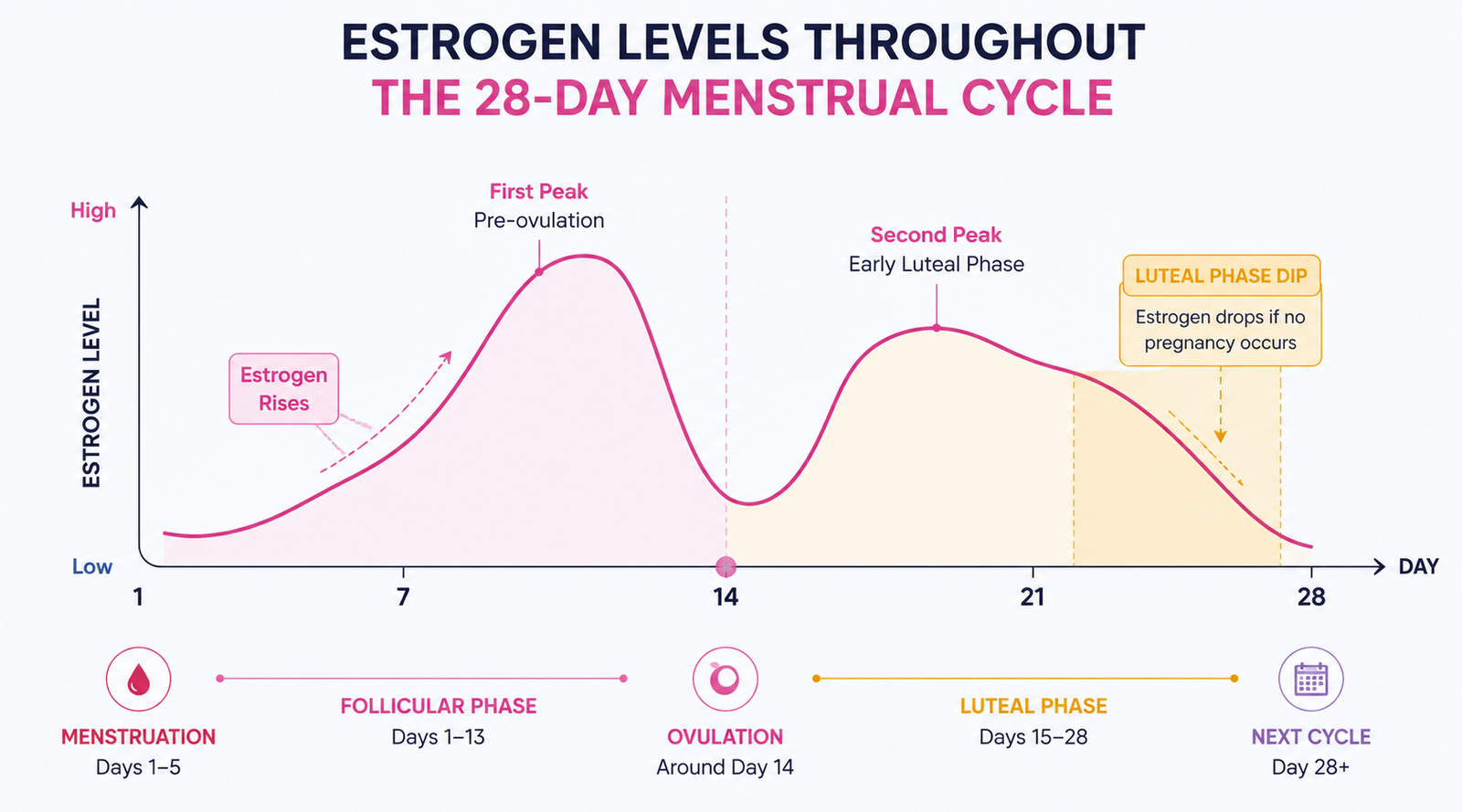
Estrogen doesn't hold steady across a menstrual cycle — it rises through the first half, peaks just before ovulation, and then falls through the second half, known as the luteal phase, before dropping further right before your period starts if pregnancy doesn't occur. That fall in the luteal phase is where premenstrual fatigue tends to concentrate.
Mayo Clinic describes premenstrual syndrome as a wide-ranging set of signs and symptoms — including mood swings, tender breasts, food cravings, fatigue, irritability, and depression — that recur in a predictable pattern tied to the menstrual cycle, and notes that as many as three in every four menstruating women have experienced some form of it. Fatigue is consistently one of the most commonly reported symptoms in that cluster, right alongside mood changes and sleep disruption.
What makes this pattern easy to miss is its predictability working against it rather than for it. Because the tiredness shows up around the same time every month, it's easy to attribute to something else happening in that particular week — a busy stretch at work, a bad night's sleep, general stress — rather than recognizing the recurring shape of it. A two-cycle symptom log, covered in Section 15, is often the fastest way to see the pattern clearly enough to describe it to a clinician.
Ordinary premenstrual fatigue is common enough to be considered a normal variation, not a disorder. The dividing line between that and something warranting evaluation is less about how tired you feel and more about how much it disrupts your ability to function — covered directly in the next section.
4. When It's More Than PMS: PMDD and Severe Cyclical Fatigue
For a smaller group of people, this same monthly pattern is severe enough to be diagnosed as premenstrual dysphoric disorder, or PMDD — a condition ACOG describes as affecting roughly 5 in 100 reproductive-aged women, most commonly in their 20s and 30s, and severe enough to cause real problems in social, academic, and work life, not simply an intensified version of typical PMS.
Fatigue is one of the core, recognized symptoms of PMDD, not an incidental one. Research comparing women with and without PMDD has found that fatigue, along with insomnia and difficulty concentrating, was measurably more severe during both the premenstrual and follicular phases in the PMDD group compared to controls — meaning the fatigue isn't confined to the days right before a period, even though it's worst then.
What Sets PMDD Apart From Ordinary Premenstrual Fatigue
- Functional impairment. The exhaustion and accompanying symptoms interfere meaningfully with work, relationships, or daily responsibilities, not just comfort.
- Predictable timing with real severity. Symptoms cluster tightly in the luteal phase and resolve within days of menstruation starting, but they're disruptive enough each cycle to be worth tracking and naming.
- A recognized diagnostic threshold. PMDD requires a specific number and pattern of symptoms confirmed prospectively across cycles, not a single bad month.
If cyclical fatigue is severe enough that you plan your life around it — avoiding commitments during a predictable week each month, or feeling like a different person during that stretch — that's a reasonable basis to bring PMDD up directly with a clinician, rather than assuming it's simply how your body works.
5. Hormonal Birth Control and Fatigue: What the Evidence Actually Shows
Starting or switching hormonal birth control is one of the more common estrogen-related changes people go through, and fatigue is a symptom many people associate with it. The honest answer here is more nuanced than most articles let on.
Fatigue is listed as a possible side effect on some oral contraceptive package inserts, but the underlying research is thinner than you'd expect for something so widely used. Much of the existing research on hormonal contraception and mood-related effects has been described as methodologically inconsistent, without uniform ways of measuring symptoms across studies — which makes it genuinely difficult to say how common contraception-related fatigue actually is, or exactly why it happens in the people who report it.
Clinicians who work with this regularly tend to describe fatigue as an uncommon but real side effect worth taking seriously rather than dismissing — the practical approach is usually to first rule out other explanations like sleep quality, iron levels, or thyroid function, since those interactions are covered further in Section 16, before assuming the contraceptive itself is the cause.
What's more consistently documented is that switching formulations, or stopping hormonal birth control altogether, causes another round of hormonal recalibration as your natural cycle resumes — which can itself produce a temporary stretch of fatigue as your body's own estrogen production finds its new rhythm again. This is a normal readjustment period, not necessarily a sign that anything is wrong, though persistent fatigue beyond a few cycles is worth mentioning at a follow-up visit.
6. The Mechanism: How Estrogen, Serotonin, and Thyroid Function Interact
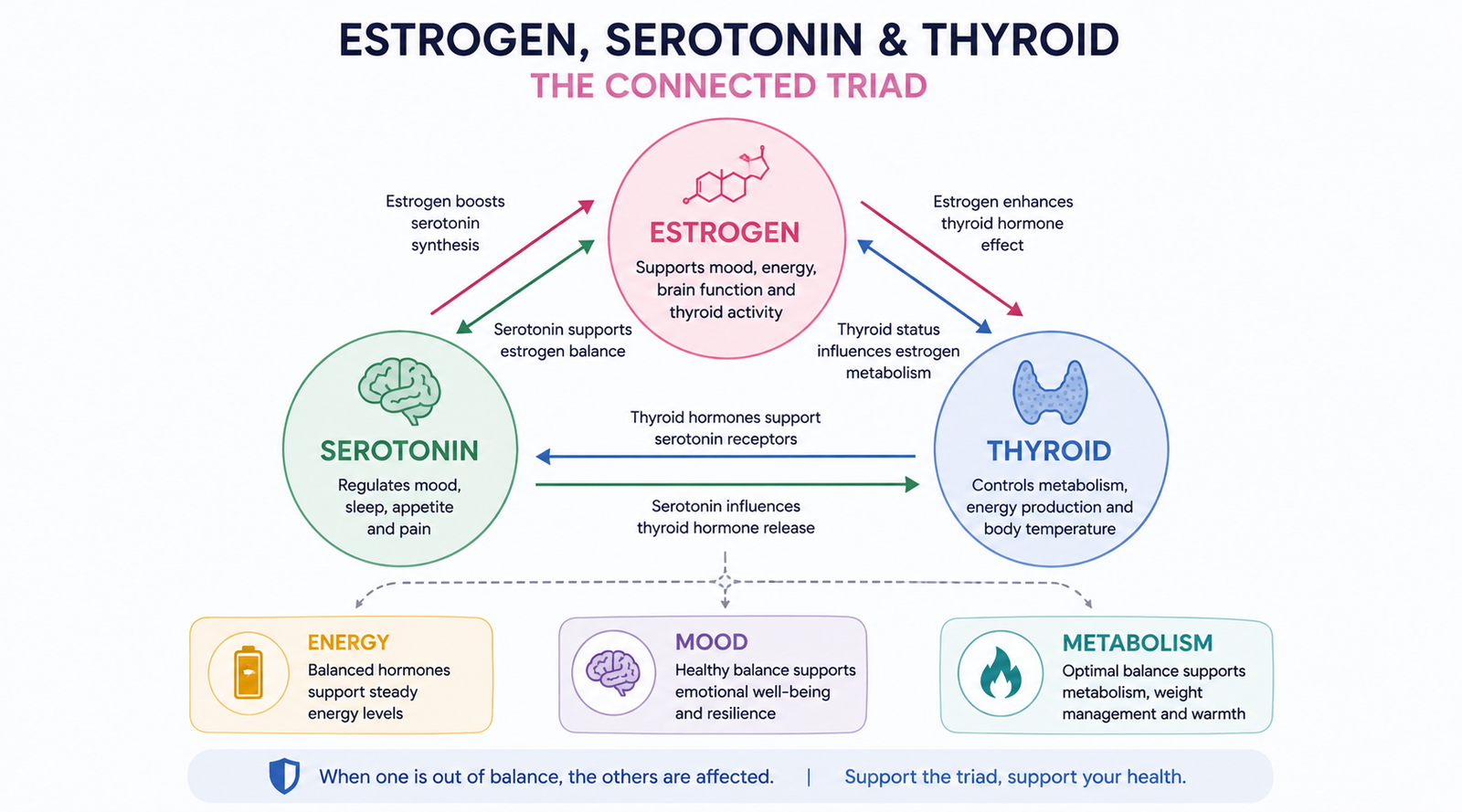
It's worth pausing to explain why a hormone best known for its reproductive role ends up affecting something as broad as energy levels. Estrogen doesn't act alone — it interacts with several other systems that more directly govern how alert or exhausted you feel.
- Serotonin regulation. Estrogen influences serotonin activity in the brain, and lower serotonin availability has long been linked to the fatigue, food cravings, and low mood that show up alongside premenstrual symptoms, which is part of why the luteal-phase dip in estrogen tends to coincide with a dip in energy and mood together, not separately.
- Thyroid interplay. The endocrine system doesn't operate in isolated silos — Johns Hopkins Medicine describes the endocrine system as a coordinated network that regulates metabolism and energy levels together, not through any single hormone acting independently. Estrogen shifts can influence how the body manages thyroid-binding proteins, which is one reason thyroid symptoms and estrogen-related symptoms are so often mistaken for each other. Our dedicated thyroid fatigue guide covers that mechanism from the thyroid side.
- Temperature and metabolic regulation. Estrogen also plays a documented role in regulating body temperature and energy expenditure, which is part of why estrogen swings can produce a sense of physical depletion that feels different from ordinary sleepiness.
The practical takeaway is that estrogen-related fatigue is rarely caused by estrogen acting in isolation — it's usually the downstream effect of estrogen's influence on two or three other systems at once, which is exactly why a proper evaluation, covered in Section 14, looks well beyond a single hormone level.
7. The Postpartum Estrogen Crash
Pregnancy involves the largest estrogen swing most bodies will ever experience — levels climb dramatically higher than at any point in a typical menstrual cycle. Then, within roughly a day or two of delivery, once the placenta (where much of that estrogen is produced) is expelled, levels fall sharply back down, often described as one of the fastest hormonal drops the body undergoes at any life stage.
This estrogen withdrawal is now understood as a meaningful contributor to postpartum fatigue and mood changes, distinct from — though often layered on top of — the sleep deprivation that comes with caring for a newborn. Some researchers describe the process as an "estrogen withdrawal state," and it's part of the reason postpartum exhaustion can feel qualitatively different from ordinary sleep-deprived tiredness: it isn't only about hours of sleep lost, it's a nervous system adjusting to a hormonal environment that changed faster than almost any other point in life.
Most people find that the sharpest edge of this hormonal fatigue eases within the first few weeks as levels stabilize, though the full return to a regular cycle can take considerably longer, especially with breastfeeding. Fatigue that intensifies rather than gradually improves in the weeks after delivery — particularly alongside low mood, anxiety, or loss of interest in the baby or usual activities — is a reasonable trigger to talk to a provider sooner rather than waiting for a routine postpartum check-up, since it may point toward postpartum depression rather than the expected hormonal adjustment alone.
8. Primary Ovarian Insufficiency: Low Estrogen Before Forty
The least commonly discussed of these four stages is also the one most likely to be missed for months or years: primary ovarian insufficiency, or POI. According to the NICHD, POI is the term used when a woman's ovaries stop working normally before she reaches age 40 — and importantly, it is not the same thing as early or premature menopause, since ovarian function in POI can be intermittent rather than permanently gone.
Cleveland Clinic notes that the most common sign of POI is irregular or missed periods, though some women with POI don't have any noticeable symptoms at all beyond that. Other reported symptoms include trouble getting pregnant, decreased sex drive, difficulty concentrating, irritability, hot flashes, and night sweats — a symptom list that overlaps heavily with fatigue-adjacent complaints, which is part of why it's so often missed.
The diagnostic delay here is a documented, real problem. The NICHD specifically warns that when providers don't test to rule out POI in a woman under 40 with irregular or absent periods, there's a risk of assuming the missed periods are simply stress-related — an assumption that delays diagnosis. If you're under 40 and have gone four or more months without a period, alongside unexplained fatigue, that combination is a specific, reasonable basis to ask directly about POI testing rather than waiting to see if your cycle returns on its own.
9. How This Differs From Other Hormone-Related Fatigue
Because estrogen-related fatigue overlaps in places with several other hormone and fatigue topics covered elsewhere on this site, it's worth being explicit about where the lines sit.
| Topic | Key Distinguishing Feature | Where to Read More |
|---|---|---|
| Perimenopause / menopause | A specific, years-long transition toward a final period, with its own distinct symptom cluster; this article deliberately doesn't re-cover that transition | Perimenopause and Menopause Fatigue |
| Low testosterone | Covers the androgen side of sex-hormone fatigue, relevant to both men and women, with an entirely separate mechanism | Low Testosterone and Fatigue |
| PCOS | A distinct diagnosed condition centered on insulin resistance and androgen excess, not estrogen fluctuation | PCOS and Fatigue |
| Cortisol / chronic stress | Covers the stress-hormone axis specifically; estrogen and cortisol can interact, but this is a different hormonal system | Cortisol and Fatigue |
| Thyroid dysfunction | A separate gland and hormone system that frequently interacts with estrogen, as covered in Section 6, but is diagnosed and treated independently | Thyroid Fatigue Guide |
Several of these conditions share overlapping symptoms — fatigue, mood changes, irregular cycles — which is exactly why self-diagnosing from a symptom list alone is unreliable. The job of a full evaluation, covered in Section 14, is telling these apart with actual lab data rather than pattern-matching from an article.
10. The Iceberg Problem: Why This Gets Dismissed as "Just Stress"
A recurring theme across all four stages covered in this article is how easily estrogen-related fatigue gets absorbed into a vaguer explanation — "I'm just stressed," "I'm just not sleeping enough," "it's probably my period." Each of those things can be true and still not be the whole story.
Part of the problem is timing blindness: because estrogen fluctuates on a schedule — monthly, postpartum, or around a contraception change — the fatigue it produces tends to arrive alongside other plausible explanations happening in the same window, which makes it easy to credit the wrong cause. Someone exhausted the week before their period is also, statistically, likely to be dealing with something stressful that week, simply because most weeks contain some stress. The hormonal contribution gets absorbed into the noise.
This is the same iceberg pattern our sleep study guide describes for sleep-disrupting events that never register in someone's own memory: the visible, easily-explained portion of the picture looks unremarkable, while the actual mechanism sits underneath, unmeasured, because nobody has looked at the pattern across cycles rather than within a single week.
11. Real-World Scenarios: Where Do You Fit?
"I'm wiped out for about a week every month, right before my period, and it's been that way for years."
This matches the ordinary luteal-phase pattern in Section 3. If it's disruptive but manageable, a two-cycle symptom log (Section 15) is a reasonable first step before assuming anything beyond typical PMS is involved.
"That same premenstrual week derails my work and relationships completely, every single month."
This level of functional disruption lines up with the PMDD pattern in Section 4, and is worth naming directly to a clinician, since PMDD has recognized diagnostic criteria and specific treatment options.
"I started a new birth control a few months ago and I've felt drained ever since."
This matches Section 5. It's reasonable to raise with whoever prescribed it — not to assume it's automatically the cause, but to rule out other explanations first and discuss whether a different formulation is worth trying.
"I'm under 35, my periods have become irregular over the past several months, and I'm constantly exhausted."
This combination points toward the primary ovarian insufficiency pattern in Section 8, and is a reasonable, specific reason to ask for hormone testing rather than assuming irregular cycles are simply stress-related.
12. What Patients Often Report: Clinical Patterns Worth Naming
A pattern many clinicians who work with reproductive hormones describe hearing repeatedly is some version of: "I thought I just had a low tolerance for stress once a month — I had no idea it was actually hormonal." That gap, between how a recurring pattern is initially interpreted and what turns out to be driving it, shows up often enough to be worth naming directly.
Another commonly reported experience comes from people who assumed postpartum exhaustion was purely about interrupted sleep, only to notice that the fatigue didn't fully lift even on nights the baby slept through — a pattern that lines up with the estrogen-withdrawal mechanism described in Section 7, where the hormonal piece is layered on top of, not identical to, sleep deprivation.
A third pattern involves people with irregular periods in their 20s or 30s who were told for months that it was "probably just stress" before anyone ordered hormone testing — a delay the NICHD specifically flags as a known risk in diagnosing POI. This lived experience is one reason it's worth asking directly for testing when irregular cycles and unexplained fatigue show up together, rather than waiting to see if things resolve on their own.
13. A Balanced View: What Estrogen Can't Explain On Its Own
It's worth being direct about the limits here. Estrogen fluctuation is a real, documented contributor to fatigue at each of the stages covered in this article, but it's rarely the complete explanation on its own, and treating it as such can mean missing something else that also needs attention.
First, several of the conditions and life stages described here share symptoms with unrelated causes of fatigue — iron deficiency, thyroid dysfunction, and sleep disorders can all produce a nearly identical picture, and can also coexist with estrogen-related fatigue rather than being an either-or situation. Second, the research on some of these connections, particularly hormonal contraception and fatigue, is genuinely less settled than confident-sounding articles online often suggest — the honest position is "plausible and reported by some people," not "definitively proven for everyone." Third, severity matters: ordinary premenstrual tiredness and PMDD sit on a spectrum, and where a given person's experience falls on that spectrum changes what's actually worth pursuing medically.
Estrogen's role in fatigue is well-supported by research at a mechanistic level — the hormone genuinely does interact with serotonin, thyroid function, and metabolism. What's less settled is exactly how much any one person's fatigue owes to estrogen specifically versus everything else happening in their life at the same time, which is precisely why a proper evaluation looks at the whole picture rather than one hormone in isolation.
14. Proper Evaluation: What a Full Workup Looks Like
Whether your pattern matches the ordinary monthly rhythm or something more disruptive, a thorough evaluation typically looks well beyond a single estrogen reading.
| Assessment | What It Evaluates | Why It's Used |
|---|---|---|
| Clinical history and cycle tracking | Timing of fatigue relative to your cycle, contraception changes, or delivery date | Determines which of the four patterns in this guide actually fits your situation before any testing begins |
| Estradiol, FSH, and LH bloodwork | Current estrogen level and whether the pituitary signals driving it are in a normal range | The core panel used to evaluate suspected POI and other estrogen-related irregularities |
| Thyroid panel | TSH and related thyroid markers | Rules in or out the thyroid-estrogen overlap described in Section 6; our TSH test guide covers this panel in depth |
| Ferritin and iron studies | Iron storage levels | Heavy or irregular bleeding tied to hormonal shifts can independently cause fatigue through low iron; our ferritin test guide explains this marker |
| Physician review in context | All results interpreted alongside your symptom timeline and life stage | Prevents any single hormone value from being over- or under-interpreted in isolation, as discussed in Section 13 |
A two-cycle symptom log, your contraception history, and (if relevant) your delivery date and breastfeeding status all give a clinician far more to work with than "I've just been really tired lately." Naming the specific pattern is often what determines whether you're offered the right test the first time.
15. Home Tracking: Building Your Own Pattern Before Your Appointment

Because estrogen-related fatigue is inherently cyclical or tied to a specific transition, a short period of structured tracking is one of the most useful things you can do before ever booking an appointment — it turns a vague sense of "I've been tired lately" into a pattern a clinician can actually act on.
Track fatigue alongside your cycle, not on its own
Rate your energy daily on a simple 1-to-5 scale for at least two full cycles, noting where you are in your cycle each day. The goal is to see whether fatigue clusters in a specific phase rather than appearing randomly.
Note contraception changes with exact dates
If you've started, stopped, or switched a hormonal method recently, record the exact date. This timeline is often the single most useful piece of information for connecting fatigue to a hormonal cause.
Log period regularity, not just fatigue
Missed, delayed, or unusually irregular periods matter as much as the tiredness itself, particularly for the POI pattern in Section 8 — write down the actual dates rather than relying on memory.
Separate "tired" from "functionally impaired"
Note not just how tired you feel but whether it stopped you from doing something — work, a commitment, a conversation. This distinction is central to differentiating ordinary PMS-level fatigue from the PMDD pattern in Section 4.
16. Interactions: Medications, Supplements, and Contraception
Estrogen doesn't operate in a vacuum, and several common medications and supplements can meaningfully interact with it or with the fatigue it produces. This isn't a complete list, and none of it replaces a conversation with a pharmacist or prescriber, but it's worth knowing what to flag.
| Substance | Relevant Interaction | Why It Matters Here |
|---|---|---|
| SSRIs / antidepressants | Sometimes used specifically to treat PMDD, often only during the luteal phase | Relevant if PMDD-level fatigue and mood symptoms are part of your pattern, as discussed in Section 4 |
| Thyroid medication | Estrogen can affect thyroid-binding proteins, which can shift how much thyroid hormone is actually available | Anyone on thyroid medication who also changes hormonal contraception should mention it, since dosing needs can shift |
| Iron supplements | Heavy or irregular bleeding tied to hormonal changes can deplete iron independently of the estrogen mechanism itself | Worth discussing if fatigue coincides with heavier-than-usual periods; see our blood tests for fatigue guide |
| St. John's Wort | Can reduce the effectiveness of hormonal contraception | Relevant for anyone combining an herbal mood supplement with birth control, since it can affect both symptom control and contraceptive reliability |
This table is meant to help you ask better questions, not to substitute for individualized advice — interactions can vary by dose, formulation, and personal health history. Bring this list to your pharmacist or prescriber rather than adjusting anything on your own.
17. The 2026 Edge: Where Research Is Heading
Two areas of active development are worth knowing about if you're navigating estrogen-related fatigue right now. The first is a growing interest in lower-dose and progestin-varied contraceptive formulations specifically aimed at reducing mood- and energy-related side effects, driven partly by the discontinuation research showing how often these side effects are the actual reason people stop a method rather than switch to a better-fitting one.
The second is diagnostic: at-home and lab-based hormone testing has become more accessible, letting people track estradiol and related markers across a cycle with less friction than a series of clinic visits. This is genuinely useful for building the kind of pattern data described in Section 15, but it doesn't replace clinical interpretation — a single home estradiol reading, taken without knowing exactly where you are in your cycle, is easy to misread. The role these tools play right now is speeding up the conversation with a clinician, not replacing it.
Awareness and diagnostic timelines for primary ovarian insufficiency have also been improving, partly because NICHD-funded research has explicitly named the delay caused by defaulting to a stress-related explanation for missed periods. That shift is slow, but it's moving in a direction that should make POI easier to catch earlier over time.
18. Red Flags: When This Needs Urgent Attention
Most estrogen-related fatigue is a gradual, manageable picture worked through with routine evaluation, but certain patterns call for faster attention:
- Thoughts of self-harm or suicide during the luteal phase, which can occur with severe PMDD and warrant immediate professional support, not just symptom tracking.
- Sudden leg swelling, chest pain, or shortness of breath while on hormonal contraception, which can signal a blood clot and needs emergency evaluation.
- Postpartum fatigue accompanied by intrusive thoughts, inability to bond with the baby, or thoughts of self-harm, which point toward postpartum depression rather than expected hormonal adjustment.
- Heavy bleeding severe enough to soak through protection hourly, alongside worsening fatigue, which can indicate significant blood loss requiring prompt care.
- No period for four or more months before age 40 alongside hot flashes or night sweats, which warrants direct POI evaluation rather than a wait-and-see approach.
These situations warrant prompt, direct medical evaluation rather than waiting for a routinely scheduled appointment, since some of the underlying causes carry real safety implications in the meantime.
19. What Actually Helps, Beyond the Diagnosis
Naming which of these four patterns fits your situation is the starting point, not the finish line. What happens afterward is usually where the actual improvement in day-to-day energy takes shape.
Treat the specific pattern, not just "fatigue" in general
PMDD, contraception-related fatigue, postpartum exhaustion, and POI each have different, targeted treatment paths — lumping them together as generic tiredness tends to lead to generic advice that doesn't fit.
Revisit your contraceptive method if the timeline lines up
If fatigue started clearly after a specific formulation change, that timeline is worth discussing directly rather than assuming you have to tolerate it indefinitely.
Rule out the overlapping causes, not just estrogen
Since iron, thyroid function, and sleep quality frequently coexist with estrogen-related fatigue, addressing only the hormonal piece can leave real improvement on the table; our broader guide to constant fatigue covers that fuller picture.
Give postpartum recovery real time, with support
The sharp estrogen drop after birth is temporary for most people, but recovery is easier with practical support around sleep and daily tasks — not something to push through silently.
20. Decision Guide — Your Situation, Your Next Step
| Your Situation | Most Likely Explanation | First Action This Week |
|---|---|---|
| Tired for about a week before your period, manageable | Ordinary luteal-phase fatigue (Section 3) | Start a two-cycle symptom log to confirm the pattern. |
| That same week derails work or relationships every month | Possible PMDD (Section 4) | Bring your symptom log to a clinician and ask about PMDD specifically. |
| Fatigue began after starting or switching birth control | Possible contraception-related fatigue (Section 5) | Note the exact start date and raise it with your prescriber. |
| Postpartum exhaustion that isn't improving with more sleep | Postpartum estrogen withdrawal, or possible PPD (Section 7) | Mention it at your next check-up; sooner if mood symptoms are involved. |
| Irregular or missed periods under age 40 with fatigue | Possible primary ovarian insufficiency (Section 8) | Ask directly for estradiol, FSH, and LH testing. |
21. Frequently Asked Questions
Can low estrogen cause fatigue even if I'm nowhere near menopause?
Yes. Estrogen fluctuates on a monthly cycle, drops sharply after childbirth, and can decline early in a condition called primary ovarian insufficiency, all independent of the menopause transition. Fatigue can appear at any of these points.
How do I know if my premenstrual fatigue is normal or something like PMDD?
The key difference is functional impairment. Ordinary premenstrual fatigue is uncomfortable but manageable; PMDD is severe enough to disrupt work, relationships, or daily responsibilities each cycle. If it's the latter, it's worth discussing directly with a clinician.
Does birth control definitely cause fatigue?
Not definitively for everyone. Fatigue is a reported and plausible side effect for some people, but the research is less consistent than many articles suggest. If fatigue started clearly after a formulation change, it's reasonable to raise with your prescriber rather than assume it's unrelated.
How soon after having a baby should postpartum fatigue improve?
Most people notice the sharpest hormonal edge of postpartum fatigue easing over the first few weeks as estrogen and progesterone stabilize, though full cycle regulation can take longer. Fatigue that worsens instead of gradually improving, especially with low mood, is worth mentioning to a provider promptly.
What's the difference between primary ovarian insufficiency and early menopause?
POI involves ovaries that stop working normally before age 40, but function can be intermittent rather than permanently gone, which distinguishes it from menopause. It's diagnosed with hormone testing and requires its own dedicated evaluation.
Should I get my estrogen level tested if I'm just feeling tired?
A single estrogen level in isolation is often hard to interpret without knowing where you are in your cycle. It's more useful to track your fatigue pattern for a cycle or two first, then bring that pattern to a clinician, who can decide which specific tests actually answer your question.
22. Summary and Next Steps
Estrogen-related fatigue isn't confined to menopause, and treating it as though it only shows up in your late 40s means missing it everywhere else it actually occurs — in a monthly cycle, after starting a new contraceptive, in the weeks after childbirth, or, less commonly, decades earlier than expected. Understanding these four distinct patterns turns a vague sense of "I'm just tired" into something specific and actionable.
What this guide actually supports is more precise, and considerably more useful:
- Estrogen fluctuates on a predictable monthly rhythm, and the luteal-phase dip is a genuine, common contributor to premenstrual fatigue.
- Severe, functionally disruptive cyclical fatigue may be PMDD, a recognized condition with its own diagnostic criteria and treatment options.
- Hormonal contraception's link to fatigue is real for some people but not definitively proven for everyone, and the honest evidence reflects that uncertainty.
- The sharp postpartum estrogen drop is a distinct mechanism from sleep deprivation, even though the two frequently overlap.
- Primary ovarian insufficiency causes low estrogen before age 40 and is too often delayed by assuming irregular periods are simply stress.
- None of these patterns should be self-diagnosed from a symptom list alone — a proper evaluation looks at hormone levels, timing, and overlapping causes together.
Scientific References
- Johns Hopkins Medicine — Estrogen's Effects on the Female Body. hopkinsmedicine.org — Estrogen's Effects on the Female Body
- Cleveland Clinic — Estrogen: Hormone, Function, Levels & Imbalances. my.clevelandclinic.org — Estrogen
- Cleveland Clinic — Primary Ovarian Insufficiency. my.clevelandclinic.org — Primary Ovarian Insufficiency
- Mayo Clinic — Premenstrual Syndrome (PMS): Symptoms & Causes. mayoclinic.org — Premenstrual Syndrome
- ACOG — What I Wish Everyone Knew About Premenstrual Dysphoric Disorder. acog.org — About PMDD
- NICHD / NIH — Primary Ovarian Insufficiency (POI). nichd.nih.gov — Primary Ovarian Insufficiency