
Blog
Psoriatic Arthritis and Fatigue: The Symptom Hiding Behind the Joint Pain


Psoriatic Arthritis and Fatigue: The Symptom Hiding Behind the Joint Pain
Swollen joints and skin plaques are what get diagnosed, but nearly half of people with psoriatic arthritis describe fatigue as one of the most disabling parts of the disease — driven by the same inflammatory cytokines attacking the skin and joints, not simply from being in pain.

- 01Why Fatigue Gets Overshadowed by Joints and Skin
- 02The Cytokine-and-Energy Connection
- 03Fatigue Doesn't Always Follow Disease Activity
- 04The Fatigue–Pain–Mood Triangle
- 05Who's Most Often Affected
- 06Overlapping Conditions Worth Knowing About
- 07Real-World Scenarios
- 08How PsA-Related Fatigue Is Evaluated
- 09What to Track Between Appointments
- 10Where Care Is Heading
- 11Red Flags Requiring Prompt Attention
- 12What Actually Helps
- 13Decision Guide
- 14Frequently Asked Questions
Why Fatigue Gets Overshadowed by Joints and Skin
Psoriatic arthritis (PsA) is a chronic inflammatory disease that develops in a meaningful share of people who have psoriasis, an immune-mediated skin condition. Mayo Clinic describes it as a form of arthritis affecting some people with psoriasis, causing joint pain, stiffness, and swelling that can range from mild to severe, alongside the visible skin plaques of psoriasis itself.
Because joint damage and skin lesions are both visible and directly measurable, they tend to dominate diagnosis and treatment conversations. Fatigue doesn't show up on an X-ray or a skin exam, yet patient-education resources consistently list it as a core symptom of the condition, alongside joint pain, nail changes, and eye involvement — and clinical surveys have found it present in close to half of people living with PsA.
Fatigue in PsA isn't automatically a sign that your disease is poorly controlled. Research has found that visible disease activity in the skin and joints doesn't always line up neatly with how fatigued someone feels, which is part of why it deserves its own conversation (Section 3).
The Cytokine-and-Energy Connection
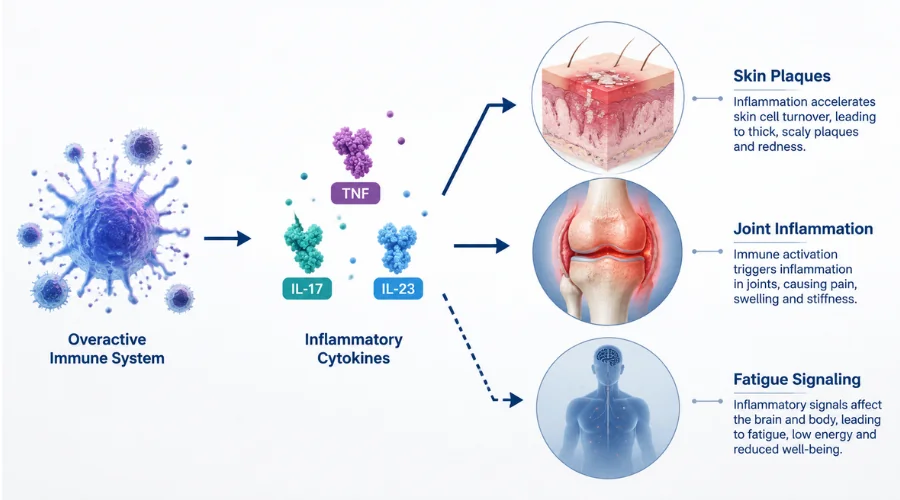
PsA is an autoimmune condition, meaning the immune system mistakenly attacks healthy tissue — in this case, primarily the skin and the joints. That immune activity is driven by inflammatory signaling molecules called cytokines, several of which are specifically implicated in PsA and targeted by modern PsA medications.
These same cytokines don't stay confined to the skin and joints. Circulating inflammatory signaling is understood to act on the brain and body more broadly, contributing to the profound, whole-body fatigue that so many people with PsA describe — a mechanism shared with related inflammatory joint diseases like rheumatoid arthritis, but specific in PsA to its own particular mix of immune pathways.
- This is a biological, immune-driven process — not simply exhaustion from dealing with pain, though pain plays a role too (Section 4).
- Fatigue is part of how PsA is measured clinically. Fatigue-specific scales, including one validated specifically for PsA, are used in both research and some clinical settings.
- Morning stiffness and tiredness often overlap, particularly for people whose disease activity is more pronounced overnight and into the early morning.
Fatigue Doesn't Always Follow Disease Activity
It would be reasonable to assume that fatigue simply rises and falls with how active a person's psoriasis and arthritis are on any given day. Research digging into this question has found a more complicated picture: in a study of outpatient PsA patients, objective measures of joint and skin involvement were not independently associated with fatigue levels — instead, how much pain and functional difficulty a person perceived, along with sleep and mood, were the stronger predictors.
That doesn't mean disease activity is irrelevant to fatigue. It means fatigue is better understood as a downstream consequence of the whole disease experience — inflammation, pain, sleep, and mood together — rather than a simple dial that turns up and down with visible flares alone.
If your skin and joints look well-controlled on treatment but fatigue hasn't improved, that's not a contradiction — it's a common pattern, and worth raising as its own separate issue rather than assuming your treatment has failed.
The Fatigue–Pain–Mood Triangle
A study of Norwegian PsA outpatients found that fatigue, pain, and sleep disturbance were all closely linked to one another, and that fatigue in particular was strongly associated with anxiety and depression. None of these fully explains the others on its own — instead, they tend to reinforce each other in a cycle.
Chronic joint and entheseal pain is exhausting on its own
Persistent pain, including at the tendon-and-bone attachment points affected in PsA, disrupts rest and consumes energy independent of visible inflammation.
Disrupted sleep compounds daytime exhaustion
Pain, itching from skin involvement, and the disease itself can all fragment sleep, directly worsening next-day fatigue.
Anxiety and depression are closely tied to fatigue severity
Mood symptoms are common in chronic inflammatory disease and show a particularly strong association with fatigue in PsA research specifically.
Who's Most Often Affected
People With More Active or Longer-Standing Disease
While fatigue doesn't map perfectly onto disease activity (Section 3), longer disease duration and higher pain burden are both associated with a greater likelihood of significant fatigue.
People With Coexisting Anxiety or Depression
Given the strong link found between mood symptoms and fatigue in PsA research, people managing depression or anxiety alongside PsA tend to report more pronounced fatigue.
People With Sleep Disruption
Nighttime pain, itching, or a separate sleep disorder all compound daytime fatigue, and sleep disturbance is common in PsA populations.
People With a Coexisting Fibromyalgia Pattern
Fibromyalgia overlaps with PsA more often than in the general population, and when present, tends to intensify both pain and fatigue (Section 6).
People With Anemia of Chronic Disease
Ongoing inflammation can itself lower red blood cell production over time, a distinct and checkable contributor to fatigue (Section 6).
§ 06Overlapping Conditions Worth Knowing About
Fatigue in PsA is frequently compounded by related conditions that are each worth naming individually rather than folding into "the PsA."
- Fibromyalgia coexists with PsA in a meaningful subset of patients — research on inflammatory joint diseases estimates fibromyalgia overlap at around 18% in PsA specifically, notably higher than in the general population.
- Anemia is recognized as a possible complication of PsA, related to chronic inflammation affecting red blood cell production, and is a distinct, checkable contributor to fatigue and low energy.
- Metabolic and cardiovascular comorbidities are more common in PsA, and conditions like obesity or poorly controlled blood sugar can independently affect energy levels.
- Sleep apnea has been associated with psoriatic disease in some research, making unrefreshing sleep worth investigating directly rather than assuming it's simply disease-related.
None of this means your fatigue has multiple separate diagnoses waiting to be found. It means several real, independently checkable contributors can layer on top of PsA's own inflammatory fatigue — and ruling them in or out (Section 8) genuinely changes what treatment looks like.
Real-World Scenarios: Where Do You Fit?
"My skin and joints are doing okay on treatment, but I'm still wiped out."
A common and recognized pattern — Section 3 covers why fatigue doesn't always track with visible disease control.
"The pain keeps me up at night, and then I'm useless the next day."
Describes the pain-sleep-fatigue cycle in Section 4, worth raising as a specific, connected pattern rather than three separate complaints.
"I also ache all over, not just in the joints that flare."
Worth asking specifically about a possible fibromyalgia overlap, described in Section 6.
"I've also felt low or anxious since this started, on top of being tired."
Worth a specific mood conversation — Section 4 covers the strong link between mood and fatigue found in PsA research.
How PsA-Related Fatigue Is Actually Evaluated
Diagnosing PsA itself typically combines a physical exam, imaging, and a history of psoriasis, often using classification criteria such as CASPAR (Classification Criteria for Psoriatic Arthritis) in research and specialist settings. Once PsA is diagnosed, evaluating fatigue specifically is a separate, more targeted process.
| Step | What It Involves | Typically Assesses |
|---|---|---|
| 1. Fatigue-specific history | Onset, pattern, and how it relates to pain, disease activity, and treatment changes | pattern |
| 2. Pain and function review | Perceived pain and physical function, which correlate more closely with fatigue than visible disease activity alone | pain |
| 3. Sleep quality screen | Nighttime pain, itching, and any separate sleep disorder | sleep |
| 4. Mood screening | Depression and anxiety symptoms, assessed as their own factor | mood |
| 5. Ruling out unrelated causes | Anemia, thyroid function, vitamin D and B12 status, and other treatable contributors | labs |
As with many chronic inflammatory conditions, the most common trap is attributing every bit of tiredness to "the PsA" without working through these layered steps — since several contributing factors above are genuinely treatable in their own right, independent of PsA disease activity.
§ 09What to Track Between Appointments

A few specific details make fatigue conversations with a rheumatologist far more actionable than a general "I'm exhausted" description.
A simple daily energy rating, logged alongside joint and skin symptoms
Helps clarify whether fatigue is tracking with disease activity or appearing independently, described in Section 3.
Pain levels, rated separately from fatigue itself
Supports the pain-and-function review described in Section 8, since perceived pain correlates more closely with fatigue than visible inflammation.
Sleep quality, including nighttime pain or itching
Directly supports the sleep screen described in Section 4 and Section 8.
Widespread aching beyond the usual flare sites
Helps identify a possible fibromyalgia overlap, described in Section 6.
Mood and motivation, noted honestly and without judgment
Supports the mood screen in Section 8, given the strong fatigue-mood link described in Section 4.
Where PsA Fatigue Care Is Heading
Fatigue has become an increasing focus in psoriatic disease research specifically because it's so consistently reported by patients as disabling, yet historically received less attention than joint damage or skin clearance in treatment trials. Researchers have called for routine fatigue examination as a standard part of psoriasis and PsA care, rather than something addressed only if a patient happens to bring it up.
There's also growing interest in better separating the inflammatory, pain-related, sleep-related, and mood-related contributors to PsA fatigue, so that treatment can target the right layer rather than assuming that treating skin and joints alone will resolve it. None of this changes the core approach for most people today: the layered evaluation in Section 8, paired with the practical strategies in Section 12, remains the foundation of care.
§ 11Red Flags Requiring Prompt Medical Attention
Most PsA-related fatigue is uncomfortable but expected. Certain accompanying symptoms call for a prompter evaluation rather than waiting for a routine appointment.
- New eye redness, pain, or light sensitivity, since PsA can involve inflammation of the eye (uveitis) that needs timely treatment.
- Sudden, severe swelling of a single joint, which can occasionally indicate infection rather than a routine flare.
- Shortness of breath or chest pain, since PsA is associated with higher cardiovascular risk that shouldn't be dismissed as simple fatigue.
- New numbness, weakness, or significant loss of joint function.
- Significant, worsening low mood or thoughts of self-harm alongside chronic fatigue — this always warrants prompt professional support regardless of the underlying cause.
What Actually Helps, Beyond the Diagnosis

Management of PsA-related fatigue generally combines treating disease activity directly with practical, evidence-informed daily strategies.
Stay engaged with active disease treatment, even if fatigue hasn't fully lifted
Since fatigue is only partly explained by visible disease activity (Section 3), well-controlled inflammation still matters, even if it isn't the whole picture.
Build in regular, joint-friendly movement
Structured, low-impact exercise is increasingly supported as a genuine fatigue-management tool in inflammatory arthritis, not just a general wellness suggestion.
Treat pain and sleep as their own separate targets
Since pain and sleep disruption are more closely tied to fatigue than disease activity alone (Section 3 and Section 4), addressing them directly often moves the needle on energy.
Practice energy pacing across the day
Spacing demanding tasks and building in rest before exhaustion hits, rather than after, helps manage the whole-body nature of PsA fatigue.
Raise mood as its own separate topic
Given the strong fatigue-mood association found in PsA research (Section 4), treating anxiety or depression specifically can meaningfully improve day-to-day energy.
Decision Guide — Your Situation, Your Next Step
| Your Situation | Most Relevant Next Step |
|---|---|
| Skin and joints look controlled, but fatigue persists | Raise it as a separate issue rather than assuming treatment has failed (Section 3). |
| Pain disrupts sleep, and fatigue follows | Describe the pain-sleep-fatigue cycle specifically at your next appointment (Section 4). |
| Widespread aching beyond your usual flare sites | Ask specifically about a possible fibromyalgia overlap (Section 6). |
| Fatigue alongside low mood or anxiety | Raise mood as its own topic, given the strong link found in PsA research (Section 4 and Section 8). |
| New eye symptoms, chest pain, or shortness of breath | Seek prompt evaluation rather than assuming it's ordinary fatigue (Section 11). |
Frequently Asked Questions
Is fatigue really a symptom of psoriatic arthritis, or is it just from the pain?
Fatigue is listed as a core symptom of PsA in patient-education resources and is reported by close to half of people with the condition, driven partly by inflammatory cytokines and partly by pain, sleep, and mood, described in Section 1, Section 2, and Section 4.
My skin and joints look fine on treatment — why am I still exhausted?
Research has found that visible disease activity doesn't always predict fatigue levels; pain, sleep, and mood tend to be stronger predictors, described in Section 3.
Could my fatigue actually be fibromyalgia instead of, or in addition to, PsA?
It's worth asking about directly — fibromyalgia overlaps with PsA in a meaningful subset of patients and, when present, tends to intensify both pain and fatigue, described in Section 6.
Is my fatigue connected to depression or anxiety?
Research has found a particularly strong association between fatigue and anxiety or depression in PsA, though the two are related rather than identical, described in Section 4.
Can exercise make PsA fatigue worse?
It can feel tiring during a flare, but regular, joint-friendly movement is increasingly supported as an effective long-term fatigue-management strategy in inflammatory arthritis, described in Section 12.
When should I see a doctor about worsening PsA-related fatigue?
If fatigue changes noticeably, doesn't follow your usual pattern, or comes with any red-flag symptoms from Section 11, it's worth a prompt conversation with your rheumatology team.
Summary and Next Steps
Fatigue in psoriatic arthritis is real, common, and driven by more than just visible disease activity.
- PsA fatigue has a real immune mechanism. Inflammatory cytokines that attack the skin and joints also affect whole-body energy regulation.
- It doesn't always track with disease control. Fatigue can persist even when skin and joints are responding well to treatment.
- Pain, sleep, and mood are closely linked to fatigue — often more closely than visible inflammation itself.
- Fibromyalgia and anemia are worth checking for directly, since both are more common in PsA and both are independently treatable.
- It's manageable. Active disease treatment, pain and sleep care, pacing, and gentle regular movement all genuinely help.
Scientific References
- Mayo Clinic — Psoriatic Arthritis: Symptoms and Causes (referenced via current clinical patient-education guidance).
- MedlinePlus (National Library of Medicine) — Psoriatic Arthritis. medlineplus.gov — Psoriatic Arthritis
- Skougaard M, et al. Psoriatic arthritis: exploring the occurrence of sleep disturbances, fatigue, and depression and their correlates, Arthritis Research & Therapy. ncbi.nlm.nih.gov — Sleep, Fatigue and Depression in PsA
- Fatigue in Psoriasis and Psoriatic Arthritis. ncbi.nlm.nih.gov — Fatigue in Psoriasis and Psoriatic Arthritis
- Fatigue in Inflammatory Joint Diseases (fibromyalgia overlap data). ncbi.nlm.nih.gov — Fatigue in Inflammatory Joint Diseases

This article is for general information and does not replace individualized advice from a licensed clinician. If you're concerned about your own symptoms, please speak with a doctor.