
Blog
Why Am I Still Tired in IBD Remission? Causes, Tests and Next Steps


Inflammatory Bowel Disease and Fatigue: Why Crohn's and Colitis Drain Your Energy
Nearly half of people with Crohn's disease or ulcerative colitis report significant fatigue — and it doesn't reliably go away just because a flare has calmed down. Inflammation, anemia, nutrient malabsorption, and even certain treatments can all play a role, often at the same time.

- 01Why IBD Fatigue Gets Overshadowed by Gut Symptoms
- 02The Inflammation-and-Energy Connection
- 03The Hidden Anemia and Nutrient Factor
- 04Fatigue Doesn't Always Follow Disease Activity
- 05Who's Most Often Affected
- 06Sleep, Mood, and Medication Effects
- 07Real-World Scenarios
- 08How IBD-Related Fatigue Is Evaluated
- 09What to Track Between Appointments
- 10Where Care Is Heading
- 11Red Flags Requiring Prompt Attention
- 12What Actually Helps
- 13Decision Guide
- 14Frequently Asked Questions
Why IBD Fatigue Gets Overshadowed by Gut Symptoms
Crohn's disease and ulcerative colitis, together known as inflammatory bowel disease (IBD), are chronic conditions in which the immune system triggers ongoing inflammation in the digestive tract. Abdominal pain, diarrhea, and rectal bleeding tend to dominate both diagnosis and day-to-day treatment conversations, since they're the symptoms most directly tied to gut inflammation and most closely tracked by gastroenterologists.
Fatigue is just as consistently reported, but it doesn't fit as neatly into a disease-activity score. Research surveying newly diagnosed IBD patients found diarrhea and fatigue to be the two most commonly reported symptoms overall — yet fatigue has historically received far less research attention and clinical focus than the gastrointestinal symptoms it so often accompanies.
Fatigue in IBD isn't just "feeling worn down by a flare." Studies have found it prevalent in roughly 40% of people even during quiescent, well-controlled disease — meaning it deserves its own conversation, separate from how your gut symptoms are doing.
The Inflammation-and-Energy Connection
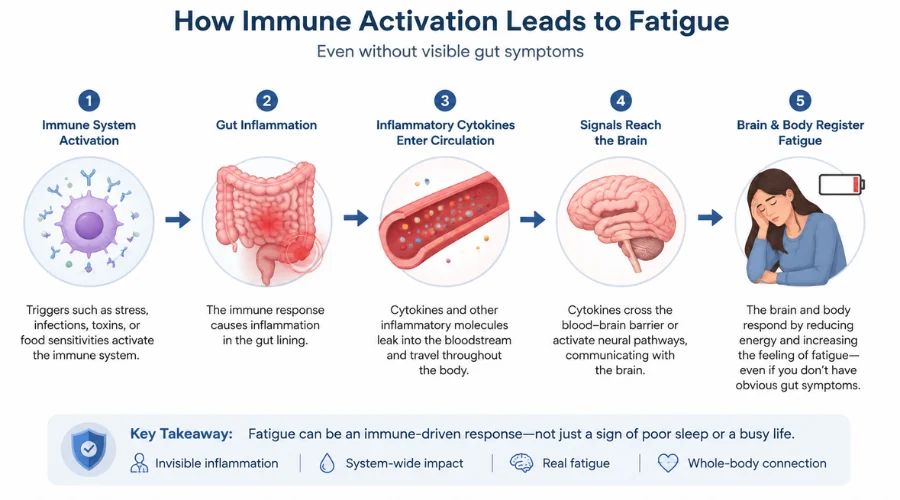
IBD is driven by an overactive immune response in the lining of the digestive tract, which produces a range of inflammatory cytokines as part of that process. These same signaling molecules circulate beyond the gut and are understood to act on the brain and body more broadly — a mechanism shared with other chronic inflammatory and autoimmune conditions, where ongoing immune activity is interpreted by the body as a reason to conserve energy.
This is one reason fatigue can be so persistent and so disconnected from how a person's gut symptoms look on any given day. A study of outpatients with IBD specifically found that despite this inflammatory link, blood levels of certain measured cytokines did not correlate directly with fatigue scores in that particular analysis — a reminder that IBD-related fatigue is more layered than "more inflammation equals more tiredness" and involves several contributing factors together (Section 4).
- Fatigue is not simply a mental or motivational issue. It's measured using validated clinical tools such as the FACIT-F fatigue scale, originally developed for cancer but validated for use in IBD specifically.
- Fatigue can be present in both Crohn's disease and ulcerative colitis, though some studies have found it somewhat more strongly associated with Crohn's disease.
- Fatigue and disability tend to move together. Research in newly diagnosed patients found fatigue strongly linked to reduced quality of life and work impairment.
The Hidden Anemia and Nutrient Factor
There's a second, very common and very checkable contributor: IBD frequently causes chronic blood loss from an inflamed or ulcerated gut lining, along with reduced absorption of key nutrients, especially in Crohn's disease affecting the small intestine. Both can lead to iron deficiency, vitamin B12 deficiency, or low vitamin D — each of which can independently cause fatigue, layered directly on top of the disease's own inflammatory fatigue.
If you have Crohn's disease affecting the small intestine, or a history of rectal bleeding with ulcerative colitis, ask specifically about iron studies, vitamin B12, and vitamin D levels rather than assuming fatigue is only coming from inflammation. These deficiencies are common in IBD and are very treatable once identified (Section 8).
Fatigue Doesn't Always Follow Disease Activity
It would be reasonable to assume fatigue simply rises and falls with how active a person's Crohn's or colitis is. Research has found a more layered picture: one study of newly diagnosed IBD patients found that fatigue was highly associated with reduced quality of life, disability, and depression independent of disease activity — meaning fatigue can be prominent even when inflammation markers and symptoms look relatively controlled.
A separate multi-year cohort following patients from diagnosis has tracked how fatigue changes over the first year of living with IBD, finding that a substantial share of patients continue to report significant fatigue at the one-year mark regardless of how their disease course has gone. This is part of why fatigue is increasingly treated as its own outcome worth measuring, not simply a proxy for disease activity.
§ 05Who's Most Often Affected
Women
Research in IBD outpatient populations has found fatigue significantly more common among women than men, a pattern consistent across several studies.
People With Crohn's Disease Specifically
Some research has found fatigue more strongly associated with Crohn's disease than with ulcerative colitis, though both groups report it at meaningfully high rates.
People With Joint Involvement
Joint disorders, a recognized complication of IBD, have been specifically linked with higher fatigue levels in outpatient studies.
People on Certain Medications
Interestingly, research has found associations between fatigue and the use of thiopurine and anti-TNF medications — common IBD treatments — which may reflect either a medication effect or that these drugs are more often used in harder-to-control disease.
People With Coexisting Depression or Psychological Distress
Psychological factors have consistently shown a strong association with fatigue severity across IBD fatigue research, though this doesn't mean fatigue is "just" depression (Section 6).
§ 06Sleep, Mood, and Medication Effects
Fatigue in IBD is frequently compounded by closely related factors worth naming individually.
- Sleep disruption is common in IBD, whether from nighttime bowel urgency, discomfort, or disease-related sleep changes, and poor sleep independently worsens daytime fatigue.
- Depression and psychological distress are consistently linked to fatigue severity in IBD research, though research specifically designed to separate disease activity from psychological factors has found both contribute independently.
- Certain IBD medications have been statistically associated with fatigue in outpatient studies, worth discussing with your gastroenterologist rather than assuming all tiredness is disease-related.
- Higher body mass index (BMI) has also been associated with fatigue in IBD outpatient research, adding another layer worth considering alongside gut-specific factors.
None of this means your fatigue has one single fixable cause. It means several real, independently checkable contributors — anemia, nutrient deficiency, sleep, mood, and medication effects — can layer on top of IBD's own inflammatory fatigue, and untangling them (Section 8) genuinely changes what treatment looks like.
Real-World Scenarios: Where Do You Fit?
"My gut symptoms are under control, but I still feel drained all the time."
A common and studied pattern — Section 4 covers why fatigue doesn't always track with visible disease activity.
"I've had ongoing rectal bleeding, and I'm short of breath climbing stairs."
Worth asking specifically about iron deficiency or anemia, described in Section 3.
"I have Crohn's affecting my small intestine, and I'm always exhausted."
Worth checking B12 and vitamin D levels specifically, described in Section 3.
"My fatigue started or worsened after switching medications."
Worth raising the specific timing with your gastroenterologist, described in Section 5 and Section 6.
How IBD-Related Fatigue Is Actually Evaluated
Diagnosing and monitoring IBD itself typically combines symptom history, blood and stool markers of inflammation, endoscopy, and imaging. Once IBD is diagnosed, evaluating fatigue specifically is a separate, more targeted process.
| Step | What It Involves | Typically Assesses |
|---|---|---|
| 1. Fatigue-specific history | Onset, pattern, and how it relates to flares, remission, and medication changes | pattern |
| 2. Disease-activity review | Inflammatory markers and symptom activity, since fatigue can occur independent of these | activity |
| 3. Iron and nutrient panel | Ferritin, vitamin B12, and vitamin D, especially with bleeding or small-intestine Crohn's | nutrients |
| 4. Sleep and mood screen | Nighttime bowel symptoms, sleep quality, and depression or anxiety | sleep/mood |
| 5. Medication review | Whether current treatments are statistically or individually associated with fatigue | meds |
As with many chronic inflammatory conditions, the most common trap is attributing every bit of tiredness to "the IBD" without working through these layered steps — since anemia, nutrient deficiency, sleep disruption, and mood symptoms are all genuinely treatable in their own right, independent of managing the underlying disease.
§ 09What to Track Between Appointments

A few specific details make fatigue conversations with a gastroenterologist far more actionable than a general "I'm always tired" description.
A simple daily energy rating, logged alongside bowel symptoms
Helps clarify whether fatigue is tracking with disease activity or appearing independently, described in Section 4.
Any rectal bleeding, its frequency and amount
Directly supports the iron and anemia screening described in Section 3 and Section 8.
Sleep quality, including nighttime bowel urgency
Supports the sleep screen described in Section 6 and Section 8.
Mood and motivation, tracked honestly and separately from fatigue
Supports the mood screen in Section 8 without assuming fatigue is "just" depression.
Any recent medication changes and how fatigue responded
Helps identify a possible medication-related contributor, described in Section 5 and Section 6.
Where IBD Fatigue Care Is Heading
Fatigue has become a growing research focus in IBD specifically because it's so often reported independent of disease activity, yet historically received far less attention than endoscopic healing or symptom scores in treatment trials. Multi-year inception cohort studies are now specifically tracking how fatigue evolves from the point of diagnosis onward, aiming to better understand which early factors predict who will have persistent fatigue a year or more later.
There's also growing interest in routine nutrient-status screening as a standard part of IBD care, given how common undiagnosed iron, B12, and vitamin D deficiencies have been found to be in this population. None of this changes the core approach for most people today: the layered evaluation in Section 8, paired with the practical strategies in Section 12, remains the foundation of care.
§ 11Red Flags Requiring Prompt Medical Attention
Most IBD-related fatigue is uncomfortable but expected. Certain accompanying symptoms call for a prompter evaluation rather than waiting for a routine appointment.
- Heavy or worsening rectal bleeding, or bleeding accompanied by dizziness or a racing heartbeat.
- Severe abdominal pain, distension, or vomiting, which can occasionally indicate a bowel obstruction needing urgent evaluation.
- High fever alongside worsening gut symptoms.
- Significant, unexplained weight loss beyond what's typical for your usual disease course.
- Significant, worsening low mood or thoughts of self-harm alongside chronic fatigue — this always warrants prompt professional support regardless of the underlying cause.
What Actually Helps, Beyond the Diagnosis

Management of IBD-related fatigue generally combines treating disease activity and any nutrient deficiencies directly with practical, evidence-informed daily strategies.
Correct iron, B12, or vitamin D deficiency if found
Since these are common and independently treatable (Section 3), correcting them can meaningfully improve energy even when disease activity is already well managed.
Stay engaged with active disease treatment
Since fatigue is only partly explained by visible disease activity (Section 4), well-controlled inflammation still matters even if it isn't the whole picture.
Build in regular, gentle physical activity
Structured, moderate exercise is increasingly supported as a genuine fatigue-management tool in chronic inflammatory conditions, when tolerated.
Protect sleep around symptom flares specifically
Since nighttime bowel urgency can fragment sleep (Section 6), addressing it directly with your care team can meaningfully improve daytime energy.
Raise mood as its own separate topic
Given the strong fatigue-mood association found in IBD research (Section 6), treating anxiety or depression specifically can meaningfully improve day-to-day energy.
Decision Guide — Your Situation, Your Next Step
| Your Situation | Most Relevant Next Step |
|---|---|
| Disease well-controlled but fatigue persists | Raise it as a separate issue rather than assuming your treatment has failed (Section 4). |
| History of rectal bleeding or small-intestine Crohn's | Ask specifically for iron, B12, and vitamin D testing (Section 3 and Section 8). |
| Fatigue that started after a medication change | Raise the timing directly with your gastroenterologist (Section 5 and Section 6). |
| Poor sleep from nighttime bowel urgency | Ask about targeted strategies for nighttime symptom control (Section 6 and Section 12). |
| Heavy bleeding, severe pain, or high fever | Seek prompt evaluation rather than assuming it's ordinary fatigue (Section 11). |
Frequently Asked Questions
Is fatigue really a symptom of Crohn's disease and ulcerative colitis, or is it separate?
Fatigue is one of the most consistently reported IBD symptoms, found in around 40% of patients even during quiescent disease, and among the two most common symptoms overall in newly diagnosed patients, described in Section 1 and Section 2.
Why am I still exhausted even though my Crohn's or colitis is well controlled?
Research has found that fatigue can be highly associated with reduced quality of life independent of disease activity, described in Section 4.
Could my fatigue actually be anemia or a nutrient deficiency instead of IBD itself?
It's possible and worth checking directly — iron, B12, and vitamin D deficiencies are common in IBD, especially with bleeding or small-intestine Crohn's disease, described in Section 3.
Could my IBD medication be causing my fatigue?
It's possible — research has found statistical associations between fatigue and certain IBD medications, including thiopurines and anti-TNF drugs, worth raising directly with your gastroenterologist, described in Section 5 and Section 6.
Can exercise make IBD fatigue worse?
It can feel difficult during a flare, but regular, gentle activity is increasingly supported as a genuine fatigue-management strategy in chronic inflammatory conditions, when tolerated, described in Section 12.
When should I see a doctor about worsening IBD-related fatigue?
If fatigue changes noticeably, doesn't follow your usual pattern, or comes with any red-flag symptoms from Section 11, it's worth a prompt conversation with your gastroenterology team.
Summary and Next Steps
Fatigue in Crohn's disease and ulcerative colitis is real, common, and driven by more than one mechanism — not simply exhaustion from gut symptoms.
- Chronic gut inflammation is a core driver of fatigue in IBD, independent of how active your bowel symptoms feel on any given day.
- Anemia and nutrient deficiency are common, checkable contributors, especially with bleeding or small-intestine Crohn's disease.
- Fatigue doesn't always track with disease control — it can persist even in well-managed, quiescent disease.
- Sleep, mood, and medication effects are separate, treatable layers, worth raising individually rather than folding everything into "I'm just tired."
- It's manageable. Correcting deficiencies, active disease treatment, sleep protection, and gentle regular movement all genuinely help.
Scientific References
- Fatigue in out-patients with inflammatory bowel disease: Prevalence and predictive factors. ncbi.nlm.nih.gov — Fatigue in IBD Outpatients
- Fatigue is highly associated with poor health-related quality of life, disability and depression in newly-diagnosed IBD patients, independent of disease activity. ncbi.nlm.nih.gov — OSCCAR Fatigue Study
- Prevalence of fatigue and its association with disease activity in UC and CD. link.springer.com — Adelphi IBD Fatigue Survey
- Fatigue Trajectory During the First Year of an Inflammatory Bowel Disease Diagnosis (IBSEN III study). pubmed.ncbi.nlm.nih.gov — IBSEN III Fatigue Trajectory
- Fatigue in Patients with Newly Diagnosed Inflammatory Bowel Disease (IBSEN III study). pubmed.ncbi.nlm.nih.gov — IBSEN III Fatigue Prevalence

This article is for general information and does not replace individualized advice from a licensed clinician. If you're concerned about your own symptoms, please speak with a doctor.