
Blog
Endometriosis and Fatigue: Why Chronic Pelvic Inflammation Leaves You Exhausted


Endometriosis and Fatigue: Why Chronic Pelvic Inflammation Leaves You Exhausted
Pain gets the spotlight in endometriosis, but for many people, exhaustion is the symptom that quietly reshapes daily life — driven by chronic inflammation, disrupted sleep, and often blood loss that's never been checked.

- 01Why Endometriosis Fatigue Is So Often Missed
- 02The Inflammation-and-Energy Connection
- 03The Hidden Blood-Loss Factor
- 04Fatigue Across the Menstrual Cycle
- 05Who's Most Often Affected
- 06Sleep, Pain, and Mood: How They Interact
- 07Real-World Scenarios
- 08How Endometriosis-Related Fatigue Is Evaluated
- 09What to Track Between Appointments
- 10Where Care Is Heading
- 11Red Flags Requiring Prompt Attention
- 12What Actually Helps
- 13Decision Guide
- 14Frequently Asked Questions
Why Endometriosis Fatigue Is So Often Missed
Endometriosis is a chronic condition in which tissue similar to the lining of the uterus grows outside it, most often around the ovaries, fallopian tubes, and pelvic lining. It's estimated to affect roughly 1 in 10 women of reproductive age worldwide, though milder cases are frequently underdiagnosed since a definitive diagnosis has traditionally required surgical confirmation. Pelvic pain, painful periods, and pain during intercourse tend to dominate both medical checklists and public awareness of the condition.
Fatigue rarely gets the same billing, even though it has been documented as a common and bothersome symptom of endometriosis for decades. Patient-education material from the National Institutes of Health lists fatigue alongside pelvic pain, heavy periods, and bloating as a core symptom of the condition — yet because it's harder to point to on a scan than a lesion or a cyst, it's often the symptom that gets least addressed in a typical appointment.
You're not imagining it, and it's not just "being tired from the pain." Fatigue in endometriosis has been studied as its own distinct symptom, with its own measurement tools, precisely because it doesn't always track with pain severity alone.
The Inflammation-and-Energy Connection
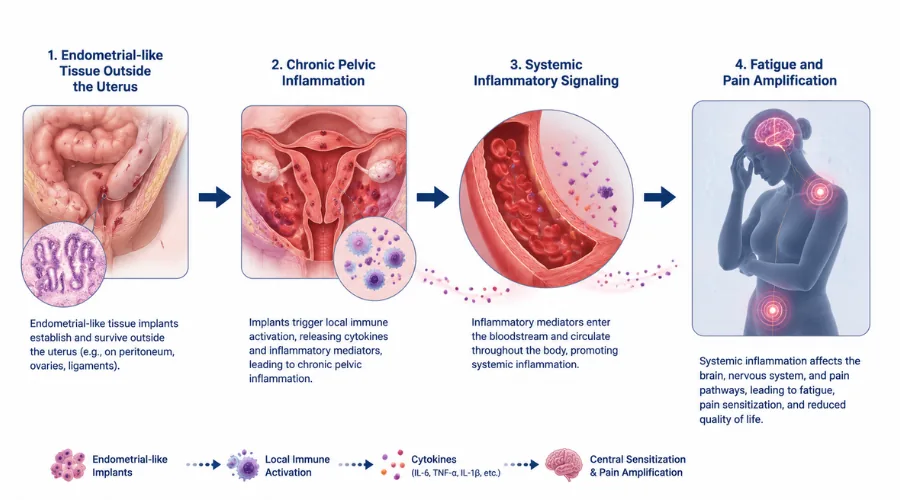
Endometriosis is increasingly understood as a chronic inflammatory disease, not simply a localized tissue problem. Displaced tissue triggers an ongoing local immune response, and research reviewing the condition's broader effects describes systemic consequences that reach beyond the pelvis, including immune dysregulation that can affect the whole body.
That chronic, low-grade inflammatory state is one of the leading explanations for why fatigue is so common in endometriosis, independent of pain. The same inflammatory signaling implicated in conditions like fibromyalgia and autoimmune disease is thought to play a role here too — the body registers ongoing internal irritation and inflammation as a reason to conserve energy, which is experienced as persistent exhaustion.
- Fatigue can be present even during pain-free stretches of the cycle, since the underlying inflammatory process doesn't fully switch off between flares.
- Fatigue and pain often amplify each other. Chronic pain is itself exhausting, and fatigue can lower the threshold at which pain feels more intense.
- This is a physiological process, not a matter of willpower. Qualitative research with people living with moderate-to-severe endometriosis-related pain describes fatigue disrupting work, relationships, and daily activities regardless of effort or attitude.
The Hidden Blood-Loss Factor
There's a second, frequently overlooked contributor: heavy or prolonged menstrual bleeding is a hallmark symptom of endometriosis, and heavy blood loss over time can lead to iron deficiency, with or without full-blown anemia. A cross-sectional study specifically screening endometriosis patients found a notably high rate of undiagnosed iron deficiency — a condition that produces fatigue, shortness of breath, and reduced quality of life largely on its own, layered directly on top of the disease's inflammatory fatigue.
If your periods are heavy or prolonged, ask specifically about iron studies (ferritin, not just a standard blood count) rather than assuming fatigue is only coming from inflammation or pain. Iron deficiency is common in this population and is very treatable once identified (Section 8).
Fatigue Across the Menstrual Cycle
Fatigue in endometriosis doesn't sit at a constant level all month. Survey data collected from thousands of people with endometriosis found that fatigue was reported as significantly worse during menstruation, and somewhat worse again around ovulation, compared with other points in the cycle. For many, this creates a predictable rhythm of worse and better weeks rather than one flat, unchanging level of exhaustion.
Recognizing that rhythm matters practically. A fatigue level that reliably worsens around your period is a different clinical picture than fatigue that stays constant regardless of cycle timing — and bringing that specific pattern to an appointment, rather than a general "I'm always tired," makes the evaluation in Section 8 far more useful.
§ 05Who's Most Often Affected
People With Heavy or Prolonged Periods
Heavy menstrual bleeding is both a common endometriosis symptom and a direct risk factor for the iron deficiency described in Section 3.
People With More Extensive or Deeply Infiltrating Disease
While fatigue doesn't always track neatly with disease severity, more extensive inflammatory involvement is generally associated with a heavier overall symptom burden.
People With Coexisting Sleep Disruption
Pelvic pain, bladder symptoms, and hormonal shifts common in endometriosis are all linked with poorer sleep quality, which independently worsens daytime fatigue.
People With Depression or Anxiety
Research has found notably elevated rates of depressive symptoms among people with endometriosis, and mood symptoms are closely tied to fatigue severity, though they don't fully explain it.
People Facing Diagnostic Delay
Years of unexplained, dismissed, or misattributed symptoms before a diagnosis is reached can itself compound the exhaustion of living with an unmanaged chronic condition.
§ 06Sleep, Pain, and Mood: How They Interact
Endometriosis-related fatigue rarely exists in isolation from these closely related factors.
- Sleep disturbance is very common in endometriosis, with one 2024 systematic review estimating that roughly 71% of people with the condition experience meaningful sleep disruption — and studies specifically link poorer sleep with higher fatigue levels.
- Chronic pelvic pain itself disrupts sleep architecture, with research showing that pain severity is associated with markedly worse sleep quality and shorter total sleep time.
- Depression and anxiety are more common in endometriosis than in the general population, and are closely associated with both fatigue and sleep disruption, forming a cycle that's easier to address when named directly rather than treated as one vague symptom.
- Bladder and bowel symptoms, including pain with urination or bowel movements, are common in endometriosis and can further fragment sleep, especially overnight.
Sleep, mood, pain, and possible iron deficiency are each independently treatable. Naming which of these is contributing most to your fatigue — rather than folding everything into "the endometriosis" — tends to open up far more concrete treatment options.
Real-World Scenarios: Where Do You Fit?
"I crash hard every month right around my period, even more than the pain alone explains."
Consistent with the cycle-linked fatigue pattern described in Section 4 — worth naming specifically as a cyclical pattern, not just "bad periods."
"My periods are really heavy, and I'm short of breath climbing stairs."
Worth asking specifically about iron deficiency, described in Section 3 — a common, treatable, and frequently overlooked contributor.
"I'm tired even during weeks when the pain is manageable."
Points toward the underlying inflammatory mechanism in Section 2, which doesn't fully switch off between pain flares.
"I barely sleep the week before my period, and then I'm exhausted for days."
Describes the sleep-and-pain interaction in Section 6, worth raising as a specific, trackable pattern.
How Endometriosis-Related Fatigue Is Actually Evaluated
Diagnosing endometriosis itself has historically relied on laparoscopic surgery for definitive confirmation, though current guidelines increasingly support starting with imaging and a detailed symptom history, reserving laparoscopy for cases where imaging is inconclusive or treatment hasn't worked. Once endometriosis is diagnosed or strongly suspected, evaluating fatigue specifically is a separate, more targeted process.
| Step | What It Involves | Typically Assesses |
|---|---|---|
| 1. Fatigue-specific history | Timing relative to your cycle, pain levels, and whether it's constant or fluctuating | pattern |
| 2. Iron studies | Ferritin and full iron panel, not just a basic blood count, especially with heavy bleeding | iron |
| 3. Sleep quality review | Screening for pain-related or hormonal sleep disruption | sleep |
| 4. Mood screening | Depression and anxiety symptoms, assessed as their own factor | mood |
| 5. Ruling out unrelated causes | Thyroid function, vitamin D and B12 status, and other treatable contributors | labs |
A common trap is treating every bit of tiredness as an unavoidable part of endometriosis, without working through these layered steps — since iron deficiency, sleep disruption, and mood symptoms are all genuinely treatable in their own right, independent of managing the underlying disease.
§ 09What to Track Between Appointments

A few specific details make fatigue conversations with a gynecologist far more actionable than a general "I'm always exhausted" description.
A simple daily energy rating, logged against your cycle day
Reveals the cyclical fatigue pattern described in Section 4.
Bleeding heaviness and duration each cycle
Supports the iron-deficiency screening described in Section 3 and Section 8.
Sleep quality, noted separately from pain levels
Helps distinguish pain-driven sleep disruption from a separate sleep issue, described in Section 6.
Pain severity, rated on its own scale from fatigue
Clarifies whether fatigue is tracking with pain flares or appearing independently, described in Section 2.
Mood and motivation, tracked honestly across the month
Supports the mood screen in Section 8 without assuming fatigue is "just" stress or low mood.
Where Endometriosis Fatigue Care Is Heading
Fatigue has increasingly been recognized in endometriosis research as a distinct, significant symptom deserving its own measurement and treatment focus, rather than an inevitable side effect of pain to simply be endured. An international patient survey exploring which treatments people actually found effective for fatigue specifically — not just for pain — reflects this shift toward treating fatigue as its own clinical target.
There's also growing attention to routine iron-status screening in endometriosis care, given how common undiagnosed iron deficiency has been found to be in this population, and continued research into the broader systemic and inflammatory effects of the disease beyond the pelvis. None of this changes the core approach for most people today: the layered evaluation in Section 8, paired with the practical strategies in Section 12, remains the foundation of care.
§ 11Red Flags Requiring Prompt Medical Attention
Most endometriosis-related fatigue is uncomfortable but expected. Certain accompanying symptoms call for a prompter evaluation rather than waiting for a routine appointment.
- Bleeding heavy enough to soak through a pad or tampon every hour for several hours in a row.
- Shortness of breath, chest pain, or a racing heartbeat, which can signal significant anemia needing urgent evaluation.
- Severe, sudden pelvic pain that's different from your usual pattern, which can occasionally signal a complication requiring urgent care.
- Fainting or near-fainting, especially around your period.
- Significant, worsening low mood or thoughts of self-harm alongside chronic fatigue and pain — this always warrants prompt professional support regardless of the underlying cause.
What Actually Helps, Beyond the Diagnosis

Management of endometriosis-related fatigue generally combines treating the underlying disease and any iron deficiency with practical, evidence-informed daily strategies.
Get iron status checked directly, especially with heavy periods
Correcting undiagnosed iron deficiency (Section 3) can meaningfully improve energy on its own, independent of endometriosis treatment.
Treat pain and disease activity as their own targets
Since inflammation is part of the fatigue mechanism (Section 2), effective pain and hormonal management can ease fatigue alongside pain itself.
Protect sleep around your period specifically
Since fatigue and sleep disruption both intensify cyclically (Section 4 and Section 6), extra rest and pain management in that window can blunt the worst of the crash.
Build in gentle, regular movement
Low-impact activity is increasingly supported as a way to ease both pain and fatigue in chronic pelvic pain conditions, even though it can feel counterintuitive during a flare.
Raise mood as its own separate topic
Treating depression or anxiety specifically, when present, is a distinct conversation from fatigue itself and can meaningfully improve day-to-day energy (Section 6 and Section 8).
Decision Guide — Your Situation, Your Next Step
| Your Situation | Most Relevant Next Step |
|---|---|
| Fatigue spikes hard around your period | Track the cyclical pattern (Section 9) and describe it specifically as cycle-linked fatigue (Section 4). |
| Heavy or prolonged periods plus fatigue | Ask specifically for iron studies, including ferritin (Section 3 and Section 8). |
| Fatigue present even during lower-pain weeks | Describe this as a possible inflammatory fatigue pattern independent of pain flares (Section 2). |
| Poor sleep, especially before your period | Raise pain-related sleep disruption directly with your care team (Section 6). |
| Heavy bleeding, shortness of breath, or severe new pain | Seek prompt evaluation rather than assuming it's ordinary fatigue (Section 11). |
Frequently Asked Questions
Is fatigue really a symptom of endometriosis, or is it just from the pain?
Fatigue has been documented as a common, distinct symptom of endometriosis for decades, and research shows it can be present even during lower-pain stretches of the cycle, described in Section 1 and Section 2.
Why am I so much more exhausted right before and during my period?
Survey data has found that fatigue is significantly worse during menstruation and somewhat worse around ovulation, a recognized cyclical pattern described in Section 4.
Could my fatigue actually be iron deficiency instead of endometriosis itself?
It's possible, and worth checking directly — undiagnosed iron deficiency has been found to be common in people with endometriosis, especially with heavy bleeding, described in Section 3.
Will treating my endometriosis also fix the fatigue?
It can help significantly, particularly by reducing inflammation and pain, but fatigue is generally treated as its own related-but-distinct target, described in Section 8 and Section 12.
Can exercise make endometriosis fatigue worse?
It can feel difficult during a flare, but gentle, regular, low-impact movement is increasingly supported as a genuine fatigue- and pain-management strategy, described in Section 12.
When should I see a doctor about worsening endometriosis-related fatigue?
If fatigue changes noticeably, doesn't follow your usual cyclical pattern, or comes with any red-flag symptoms from Section 11, it's worth a prompt conversation with your gynecology team.
Summary and Next Steps
Fatigue in endometriosis is real, common, and driven by more than one mechanism — not simply exhaustion from pain.
- Chronic pelvic inflammation is a core driver of fatigue in endometriosis, independent of how severe your pain feels on any given day.
- Heavy bleeding can cause hidden iron deficiency, a separate, common, and very treatable contributor worth checking directly.
- Fatigue often follows your cycle, worsening around menstruation and ovulation — tracking that rhythm makes it easier to manage and easier to explain to a doctor.
- Sleep and mood are separate, treatable layers, worth raising individually rather than folding everything into "I'm just tired."
- It's manageable. Iron correction, active disease treatment, sleep protection around your period, and gentle movement all genuinely help.
Scientific References
- MedlinePlus Magazine (National Library of Medicine) — Endometriosis: What You Need to Know. magazine.medlineplus.gov — Endometriosis Overview
- Yu J, et al. High prevalence of undiagnosed iron deficiency in endometriosis patients: A cross-sectional study. ncbi.nlm.nih.gov — Iron Deficiency in Endometriosis
- Prevalence of sleep disturbances in endometriosis patients: a systematic review and meta-analysis. frontiersin.org — Sleep Disturbance in Endometriosis
- Perceived effectiveness of endometriosis therapies on fatigue: an international survey. ncbi.nlm.nih.gov — Endometriosis Fatigue Treatment Survey
- A qualitative study of endometriosis-related fatigue. link.springer.com — Endometriosis-Related Fatigue

This article is for general information and does not replace individualized advice from a licensed clinician. If you're concerned about your own symptoms, please speak with a doctor.


