Blog
Why Am I Still Tired After 8 Hours of Sleep? (2026 Clinical Authority Guide)

Introduction
Most people believe that sleeping 7–9 hours automatically guarantees good energy the next day. This belief is so deeply embedded in public understanding that it is rarely questioned. However, in clinical sleep medicine, this assumption is one of the most common misconceptions encountered in patients with chronic fatigue.
A very frequent pattern appears in clinical practice: individuals report sleeping a full night—often 7, 8, or even 9 hours—but still wake up feeling unrefreshed. They describe mental fog, physical heaviness, lack of motivation, and persistent daytime fatigue.
This condition is not psychological imagination, nor is it rare. It reflects a mismatch between sleep duration and sleep quality.
Sleep is not a simple state of “being unconscious for a number of hours.” It is a highly organized biological process involving coordinated brain wave cycles, hormonal regulation, respiratory stability, metabolic repair, and autonomic nervous system recalibration.
 When any part of this system is disrupted, total sleep duration becomes a poor indicator of actual recovery.
Sleep Is a Multi-System Biological Recovery Process
Sleep is structured into repeating cycles, each lasting approximately 90–110 minutes. Within each cycle, the brain moves through distinct stages:
- N1 (light sleep transition)
- N2 (stable light sleep)
- N3 (deep sleep / slow-wave sleep)
- REM sleep (rapid eye movement phase)
Each stage plays a specific biological role.
Deep Sleep (N3 Stage)
Deep sleep is the most restorative phase of sleep. During this stage:
- Growth hormone secretion increases
- Tissue repair occurs
- Immune system activity strengthens
- Cellular regeneration is activated
This is the phase most directly associated with physical recovery.
REM Sleep
REM sleep is responsible for:
- Memory consolidation
- Emotional regulation
- Cognitive processing
- Brain plasticity
It is essential for mental recovery and emotional stability.
Light Sleep (N1–N2)
Light sleep acts as a transition system between deeper stages. Although less restorative, it is necessary for maintaining sleep continuity.
Clinical evidence shows that reduced deep sleep (N3) is strongly associated with next-day fatigue even when total sleep duration is normal.
This means that two individuals can both sleep 8 hours, but feel completely different the next day depending on sleep architecture quality.
The Core Problem: Sleep Quality vs Sleep Duration
The key misunderstanding is assuming that sleep quantity equals recovery.
In reality:
Sleep duration = total time spent in bed
Sleep quality = efficiency of biological recovery processes
Sleep quality depends on:
- Continuity of sleep cycles
- Oxygen stability
- Hormonal balance
- Nervous system regulation
- Absence of micro-awakenings
 If any of these are disrupted, sleep becomes non-restorative even if it appears “normal” on the surface.
Major Clinical Causes of Feeling Tired After 8 Hours of Sleep
1. Sleep Apnea (Most Undiagnosed Cause of Chronic Fatigue)
Obstructive sleep apnea is one of the most clinically significant causes of persistent fatigue.
In this condition, the upper airway partially or completely collapses during sleep, leading to repeated breathing interruptions. These interruptions reduce oxygen levels and trigger micro-awakenings.
Most patients do not remember these awakenings.
However, the physiological impact is severe:
- Oxygen desaturation during sleep
- Repeated sleep fragmentation
- Loss of deep sleep continuity
- Increased sympathetic nervous system activity
Over time, this leads to chronic fatigue, even in individuals who report sleeping 8–9 hours per night.
External reference:
https://www.sleepfoundation.org/sleep-apnea
2. Sleep Fragmentation (Invisible Sleep Disruption)
Internal Pillar Article
For deeper understanding, read:
Why Am I Always Tired? (Ultimate 2026 Clinical Authority Guide)
Sleep fragmentation occurs when sleep is repeatedly interrupted at a micro level without full awakening.
These interruptions can be caused by:
- Noise
- Temperature changes
- Light exposure
- Stress activation
- Internal physiological signals
Even if the person does not consciously wake up, the brain repeatedly shifts from deep sleep to lighter stages.
This significantly reduces sleep efficiency.
Fragmented sleep is strongly associated with:
- Morning fatigue
- Cognitive slowing
- Reduced alertness
- Poor emotional regulation
Internal Link Placement (IMPORTANT)
Place this link immediately after sleep fragmentation section:
/why-am-i-still-tired-after-8-hours-sleep-causes
This page should cover deeper diagnostic causes and medical explanations.
3. Cortisol Imbalance (Stress Hormone Dysregulation)
Cortisol is a hormone that regulates alertness and follows a strict circadian rhythm:
- High in the morning
- Low at night
In chronic stress conditions, this rhythm becomes disrupted.
Cortisol remains elevated at night, resulting in:
- Delayed sleep onset
- Reduced deep sleep
- Increased nighttime alertness
- Reduced recovery quality
 Scientific literature consistently shows elevated evening cortisol is linked with poor sleep efficiency and increased fatigue.
External reference:
https://www.health.harvard.edu/staying-healthy/how-stress-affects-your-sleep
4. Circadian Rhythm Disruption
The circadian rhythm is the body’s internal biological clock that regulates:
- Sleep timing
- Hormone release
- Body temperature
- Metabolism
When this rhythm becomes misaligned due to:
- Irregular sleep schedules
- Night screen exposure
- Shift work
- Late-night stimulation
sleep quality declines even if duration remains unchanged.
Timing is biologically as important as duration.
5. Nutrient Deficiencies and Cellular Energy Failure
Fatigue is not always sleep-related. It can be metabolic.
Iron is essential for oxygen transport. Low iron levels reduce oxygen delivery to tissues even before anemia develops.
Vitamin B12 is essential for:
- Nervous system function
- Energy metabolism
- Cognitive performance
Deficiencies may cause:
- Fatigue
- Brain fog
- Weakness
- Reduced mental clarity
External reference:
https://www.nhlbi.nih.gov/health/iron-deficiency-anemia
6. Modern Lifestyle Sleep Disruption
Modern habits significantly affect sleep biology:
- Blue light delays melatonin release
- Caffeine blocks adenosine receptors for hours
- Social media increases cognitive stimulation
- Late-night mental activity delays sleep onset
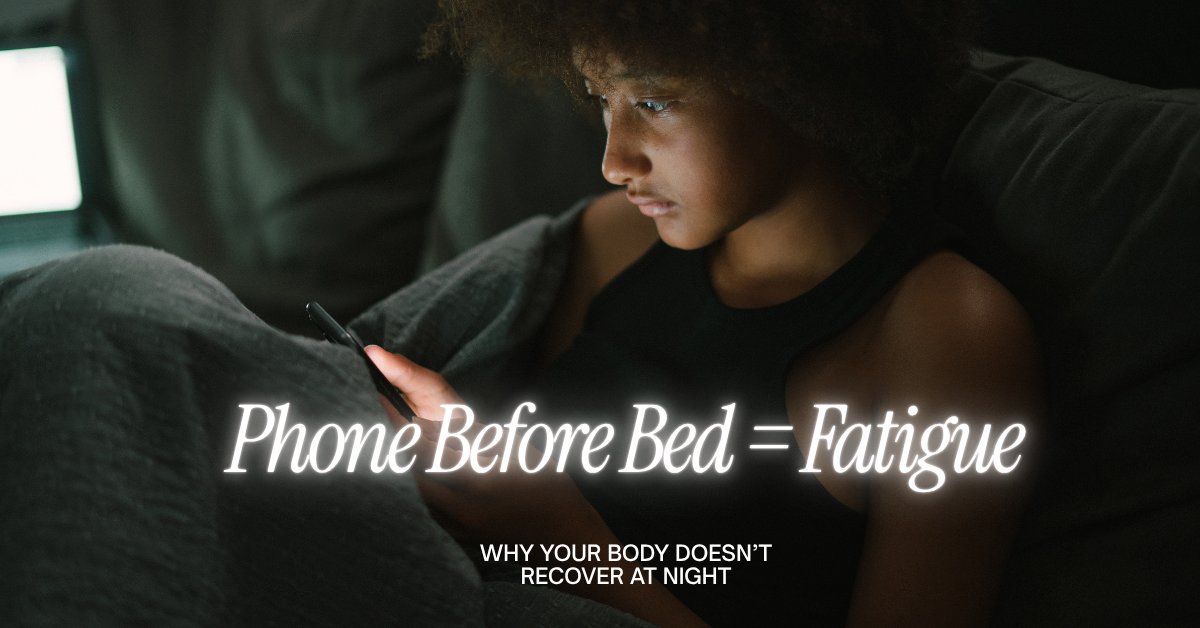 These factors reduce deep sleep percentage and delay recovery cycles.
7. Sleep Efficiency vs Sleep Duration
Sleep efficiency refers to the percentage of sleep spent in restorative stages.
Research shows:
- Sleep efficiency is a stronger predictor of fatigue than total duration
- Poor efficiency can exist even with 8–9 hours of sleep
This explains why some people feel exhausted despite “enough sleep.”
8. Why Sleep Trackers Can Be Misleading
Most wearable devices estimate sleep using:
- Movement (actigraphy)
- Heart rate variability
However, they cannot measure:
- Brain wave activity (EEG)
- Sleep stage accuracy
- Micro-awakenings precisely
This leads to overestimation of sleep quality in many cases.
9. When Fatigue Becomes Clinically Important
Internal Pillar Article
For deeper understanding, read:
Why Am I Always Tired? Causes of Constant Fatigue (Sleep, Stress & Hormones – 2026 Guide)
Fatigue should not be ignored if it persists for weeks and includes:
- Morning headaches
- Cognitive impairment
- Shortness of breath
- Loud snoring
- Excessive daytime sleepiness
Possible underlying conditions include:
- Sleep apnea
- Thyroid disorders
- Anemia
- Chronic inflammation
Internal Link Placement (IMPORTANT)
Place this link here before interventions section:
/why-am-i-still-tired-after-8-hours-sleep-solutions
 This page should focus on treatments, corrections, and lifestyle fixes.
10. Evidence-Based Strategies to Improve Sleep Quality
Clinical strategies that improve sleep quality include:
Morning sunlight exposure to regulate circadian rhythm
Consistent sleep schedule to stabilize hormonal cycles
Reducing screen exposure before bedtime
Limiting caffeine intake after early afternoon
Stress reduction techniques such as breathing exercises
These interventions improve sleep efficiency and deep sleep duration.
11. Decision Framework for Understanding Fatigue
Fatigue can generally be classified into four categories:
Stress-related fatigue: cortisol imbalance and hyperarousal
Sleep-related fatigue: apnea or fragmentation
Metabolic fatigue: nutrient deficiencies
Lifestyle fatigue: circadian misalignment
Correct classification is essential for effective treatment.
12. External High Authority References
Sleep Foundation
https://www.sleepfoundation.org/
Harvard Medical School Sleep Research
https://www.health.harvard.edu/topics/sleep
Mayo Clinic Sleep Apnea Overview
https://www.mayoclinic.org/diseases-conditions/sleep-apnea
National Institutes of Health (NIH) Sleep Research
https://www.nhlbi.nih.gov/science/sleep
Final Conclusion
Feeling tired after 8 hours of sleep is not unusual in modern populations. It is most often the result of disrupted sleep architecture rather than insufficient sleep duration.
The most common causes include sleep fragmentation, sleep apnea, hormonal imbalance, circadian disruption, and nutrient deficiencies.
True recovery depends not on how long sleep lasts, but on how effectively the body completes its
 biological restoration processes during sleep.